

Hey there! If you’ve ever been curious about what those gifts are all about, you’re not alone. Many people have heard a bit about them but don’t really grasp their significance. That’s totally okay! This article is here to walk you through each gift in simple terms, no theology degree needed.
These aren’t just fancy ideas meant for saints or scholars. Every baptized Christian receives these gifts as part of their spiritual inheritance. They’re meant to be actively used in daily life, not just admired from afar. I can tell you, learning about these gifts changed how I approach everyday challenges.
So, get ready! We’ll break things down step by step, from what these gifts are to how you can grow in them. It’s all about making your faith feel more connected to your life. Let’s dive in!
Key Takeaways
- Many Catholics are familiar with these gifts but may not understand their true meaning.
- This article simplifies each gift, making it relatable to everyday life.
- These gifts are given to all baptized Christians, not just a select few.
- They are practical tools for navigating daily decisions and challenges.
- Understanding these gifts can enhance your faith journey.
What Are the Gifts of the Holy Spirit?
Let’s explore what these gifts really mean. These gifts are supernatural helps from God. They make us more open to following where the Holy Spirit leads, acting like spiritual instincts in our lives.
Unlike skills you can learn from a book, these gifts are given directly by God. They grow as you cooperate with them. The Catholic Church teaches that these gifts come to us at baptism. This means every baptized person already has them, even if they don’t feel particularly gifted or holy.
The seven gifts work hand in hand with virtues like faith, hope, and charity. They help those virtues become stronger and more alive in our daily choices. St. Thomas Aquinas described these gifts as habits that help us move beyond just human reasoning. They enable a deeper connection with God.
These gifts fit into the bigger picture of Catholic life. They aren’t something separate or mystical. Instead, they serve as practical tools for navigating everything from big decisions to small daily moments. One insightful point from tradition is that the gifts are meant to make us docile to the Spirit. This doesn’t mean being passive; rather, it means being ready and willing to respond when God nudges us.
Understanding what these gifts are is just the first step. The rest of this page will dive into the nitty-gritty of each one and how they actually show up in real life.
| Gift | Description | Related Virtue |
|---|---|---|
| Wisdom | Seeing life through God’s eyes | Faith |
| Understanding | Grasping the heart of things | Hope |
| Counsel | Knowing which way to go | Prudence |
| Fortitude | Finding courage when it’s tough | Justice |
| Knowledge | Choosing the right path | Temperance |
| Piety | Living with reverence and love | Charity |
| Fear of the Lord | Awe and respect that keeps us close | Faith |
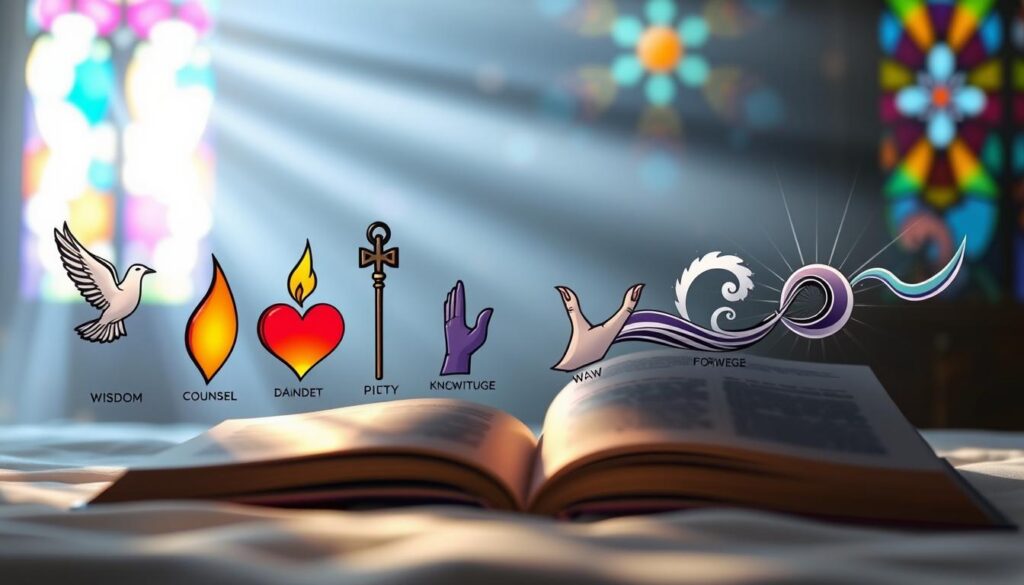
Breaking Down the Seven Gifts of the Holy Spirit Catholic
Now, let’s take a closer look at each of the seven gifts highlighted in scripture and tradition. Each gift plays a unique role in our lives, helping us connect more deeply with God and others.
Wisdom: Seeing life through God’s eyes
Wisdom isn’t just about making smart choices. It’s about seeing things from God’s perspective. This gift helps you align your heart with what truly matters. With spirit wisdom, you gain insight that puts everything in order, guiding you in your decisions.
Understanding: Grasping the heart of things
Understanding goes beyond mere facts. It gives you a penetrating insight into deeper truths about God and life. This gift allows you to grasp what you can’t just figure out with your mind alone. It’s like seeing the world through a lens that reveals the essence of things.
Counsel: Knowing which way to go
Counsel acts like a spiritual GPS. When you’re stuck or facing tough decisions, this gift helps you find the right path. It provides right judgment that goes beyond weighing pros and cons. With counsel, you feel directed by God in your choices.
Fortitude: Finding courage when it’s tough
Fortitude is the gift of courage. It’s not about being fearless but having the strength to do what’s right, even when it’s hard. This gift kicks in when challenges arise, helping you push through difficult situations with firmness of mind.
Knowledge: Choosing the right path
Knowledge allows you to judge correctly about matters of faith and action. It helps you choose the right path and avoid confusion or sin. This gift is closely tied to making good judgments in your daily life, guiding you toward a more faithful existence.
Piety: Living with reverence and love
Piety isn’t about being overly religious. It’s about having a deep reverence and love for God that spills over into how you treat others. This gift reminds you that everyone is connected to God in some way, inspiring you to act with kindness and respect.
Fear of the Lord: Awe and respect that keeps us close
Fear of the Lord isn’t about being scared of God. It’s about having profound awe and respect for Him. This gift helps you stay close to God, fostering a desire to avoid separation from Him. It’s a reminder of His greatness and love.
Jesus Christ is the perfect example of all these gifts lived out fully. He shares them with us so we can become more like Him. Each gift builds on the others, working together in our lives. As we grow in one gift, the others begin to flourish too. The rest of this page will show how these gifts play out in real situations.

The Biblical Roots Behind the Gifts
Let’s dive into the biblical roots that shape these gifts. The idea of the seven gifts in scripture originates from a single passage in Isaiah. This is significant because it highlights that these gifts were always intended to be practical.
Isaiah 11:1-3 reads,
“There shall come forth a shoot from the stump of Jesse, and a branch shall grow out of his roots. And the Spirit of the Lord shall rest upon him, the spirit of wisdom and understanding, the spirit of counsel and might, the spirit of knowledge and the fear of the Lord. And his delight shall be in the fear of the Lord.”
This prophecy points directly to Jesus Christ. The gifts are qualities that reflect His nature, which is quite remarkable. The image of the Spirit of the Lord resting on the shoot of Jesse shows that these gifts are not something we earn. Instead, they flow from God’s presence in our lives.
Moreover, the phrase about the fear of the Lord in Isaiah isn’t about being terrified. It’s about finding delight in reverence, which completely transforms our understanding of that gift.
These gifts didn’t just appear out of nowhere. They are deeply rooted in the Old Testament wisdom tradition. Books like Proverbs and Ecclesiastes provide practical guidance on everyday issues like money, relationships, and making good choices.
The wisdom literature focuses on living out the covenant in real-life situations. This aligns perfectly with what these gifts are meant to help us achieve today.
The Catholic Church has recognized Isaiah 11 as foundational for understanding these gifts. For over two thousand years, commentators have revisited this passage to grasp their significance.
It’s crucial to note that these gifts were never meant to be mystical or distant. They are about engaging with the world and actively building God’s kingdom in practical ways.
Understanding these biblical roots gives us a clearer insight into the nature of the gifts. They are meant for ordinary people living everyday lives, not just for spiritual elites.

How These Gifts Show Up in Your Daily Life
The gifts from the Holy Spirit aren’t just for Sunday services; they show up in our everyday lives. These gifts often reveal themselves in ordinary moments, guiding us in ways we might not even notice at first.
Spotting the gifts in everyday moments
For instance, think about a time when you faced a conflict at work. Suddenly, you just knew how to handle it. That was wisdom at play. It’s that moment when you realize the right way to approach a tough conversation with a family member, feeling guided by something greater than yourself.
Stories and examples that feel familiar
Understanding can kick in when you’re reading Scripture. Maybe you hear a homily, and something clicks in a way it never has before. You gain deeper insight into what God is saying, and it feels like a light bulb just turned on.
Counsel often appears when you’re stuck on a decision. A friend might say something that resonates, or a thought pops into your head, providing the clarity you needed. Later, you realize that was the Holy Spirit guiding you.
Fortitude is that surge of courage you feel when you need to stand up for what’s right. Perhaps you speak up for someone being treated unfairly or stick to your faith when it’s not popular. That inner strength comes from the Holy Spirit.
Knowledge helps you make better decisions day to day. It might encourage you to walk away from gossip or spend your time on something meaningful instead of scrolling through your phone. This gift helps you focus on what truly matters.
Piety shows up in how you treat others. It’s a kind of reverence and love that comes from recognizing everyone is connected to God, even that person who’s driving you crazy. This awareness can transform your interactions.
Fear of the Lord is that sense of wonder you feel when you’re in nature or during the Eucharist. It’s a holy respect that keeps you grounded and close to God, reminding you of His greatness.
These gifts often work together in a single situation. The more you pay attention, the more you’ll start to spot them in your life. So, take a moment to look for these gifts and trust that they’re already at work, even if you haven’t noticed them before.

Why Most Catholics Miss Out on These Gifts
If you’ve ever felt confused about the gifts, you’re not alone. Many people who went through confirmation often learned the names of these gifts by rote. It was like memorizing a list for a test. But what about understanding what they actually mean or how they apply to real life?
It’s frustrating to think that the Catholic Church has sometimes dropped the ball on this teaching. Instead of diving deep into the gifts, many programs focus more on virtues or other aspects of faith. As a result, these powerful gifts often get pushed to the side.
Confirmation prep can be a whirlwind. Often, it rushes through the gifts in just one class or a few pages in a textbook. Then, everyone moves on, forgetting about them. This is a shame because these gifts are such a vital part of our spiritual inheritance.
One big issue is that these gifts often seem mystical and out of reach. They can feel like they’re only for saints or religious folks. But the truth is, they’re meant for every baptized person, including you.
Another problem is that many people miss the connection between the gifts and virtues. Without this understanding, it’s hard to see how they work together to shape a faithful life. Even the Catechism doesn’t devote much time to the gifts compared to other topics, which might explain why most religious education programs don’t go deep on this subject.
The good news? It’s never too late to learn about these gifts and start living them out. Recognizing this gap is the first step. Now, we can focus on actually growing these gifts instead of just feeling bad about missing out earlier.
Growing the Gifts: Tips That Actually Work
Nurturing these gifts can be simple and rewarding. It’s not about following a complicated program. Instead, it’s about developing a few habits that make a real difference over time.
First, let’s talk about prayer. This is the foundation for everything. It’s not just about reciting prayers but truly asking the Holy Spirit to stir up those gifts within you. Make it a regular part of your prayer life to ask for wisdom, courage, or whatever gift you need most right now.
Prayer and asking for the Spirit
One of the best things you can do is to talk to God honestly about your day and the decisions you’re facing. When you do this, you’re opening yourself up to receiving counsel and knowledge in practical ways.
Walking faithfully in virtue
Next, think about walking faithfully in virtue. This is like exercise for your gifts. The virtues and gifts are connected. When you practice patience, charity, or temperance, you’re creating the right conditions for the gifts to grow.
The virtue of charity is especially important. It acts like the key that unlocks the power of the gifts. Focusing on loving God and your neighbor is one of the most effective ways to see those gifts come alive.
Trusting God in your daily decisions
Also, trust God in your daily decisions, even the small ones. Each time you rely on Him instead of just your own reasoning, you’re giving the gifts room to work.
Pay attention to the fruits of the Spirit in your life. Things like peace, joy, and patience are signs that the gifts are active. This isn’t about being perfect or having it all figured out. It’s about taking small steps and being patient with yourself.
Remember, the gifts grow gradually as you cooperate with grace. So, pick one or two things from this page to focus on. Don’t try to do everything at once. The Holy Spirit works with us where we are.
Using the Gifts Like a Soldier of Christ
Let’s explore how to wield these gifts like powerful tools in our journey. The phrase “soldier of Christ” might sound intense or old school, but it really captures what we face in daily life. Recognizing our role in this spiritual battle can be incredibly empowering.
Seeing everyday life as spiritual warfare doesn’t mean we’re looking for demons around every corner. Instead, it’s about understanding there’s a real struggle between good and evil. We’re part of this battle, whether we like it or not.
The gifts provided by the Holy Spirit are like spiritual tools or weapons. They help us fight the good fight—not against people, but against sin, temptation, and discouragement. These gifts pull us closer to God and strengthen our resolve.
When you start viewing daily challenges through this lens, things shift. Standing up for your faith at work or resisting a bad habit becomes more than just being nice. You’re engaging in something much bigger.
But remember, these gifts don’t just show up automatically. They emerge as you step into the fight. You have to be willing to use them, even when it feels uncomfortable. That’s where real growth happens.
Fortitude, counsel, and fear of the Lord become especially important when you face opposition. Doing what’s right often costs something, and that’s when you need to remember you’re equipped for this.
In a world full of distractions and temptations, it’s easy to feel defenseless. But with these gifts, you have everything you need to stay faithful and even thrive. They’re not just resources; they’re essential for navigating life’s battles.
So, think of yourself as a soldier of Christ—not with arrogance, but with humble confidence. God has equipped you for the battles you face every day. Embrace your role and remember that you’re stronger than you think.
Carrying the Gifts Forward Every Day
Every day is a new chance to embrace the gifts bestowed upon us. Remember, these gifts aren’t just for special occasions; they’re for daily living. Each new day brings fresh opportunities to use them, whether it’s showing patience with your kids or making a big career decision.
These gifts are part of our inheritance as baptized Christians. They never expire or run out. Keep learning and growing in your faith. Don’t be discouraged if you forget to rely on them sometimes. The Holy Spirit is patient and always working with us.
The goal isn’t just to be a good person but to become the kind of person Jesus described in the Beatitudes. Carrying these gifts forward means staying close to the sacraments, praying, and connecting with others on the same journey.
So, take that next step, whatever it looks like, and trust that the Spirit is already at work, making these gifts alive and active in your life.