

The phrase high frequency has two common meanings. In radio, it points to a specific part of the spectrum. In daily life, people use it to describe a bright mood, steady energy, or hopeful feelings.
The simple trick is to choose encouraging words and thoughts on purpose. This practice can help shape your outlook, but it isn’t a scientific radio-frequency treatment. Think of it as a mindful habit for starting your day with intention.
In technical terms, HF covers the 3 to 30 megahertz radio band. Shortwave signals in this range can travel across long distances. In casual speech, someone might say, “I’m staying on a high frequency today,” after a good workout, calm breakfast, or uplifting conversation.
A Rensselaer adult-use cannabis dispensary also uses the phrase in its name while serving the Capital Region. This guide separates radio facts from self-help language, so each meaning stays clear. For more ideas about feeling uplifted, explore these vibrational habits.
Key Takeaways
- The phrase has technical and everyday meanings.
- HF spans 3 to 30 MHz.
- Encouraging thoughts can support a better outlook.
- Positive routines may shape your mood.
- This guide keeps both meanings separate.
High Frequency Meaning and Definition
Context gives this term its meaning. In radio, high frequency is a noun phrase for the 3 to 30 MHz band. The International Telecommunication Union lists it as radio band 7, a measured part of the electromagnetic spectrum.
In simple terms, frequency describes how often a signal or event repeats. Dictionary definitions from sources such as Dictionary.com Unabridged and Collins English Dictionary help explain the technical use. They also show how one word can take on a different meaning in casual speech.
Radio meaning as a noun
As a noun, the term names a recognized radio range. It does not describe a person’s mood or energy. This clear distinction makes the definitions easier to follow.
Everyday use and context
In everyday usage, people may use high frequency to describe optimism, lively energy, or a good mood. This personal-growth meaning is informal, not a scientific measurement.
“A walk before work helps me stay on a high frequency all morning.”
Other example sentences may describe a cheerful song, a refreshing workout, or an encouraging conversation. The surrounding sentences reveal which meaning the speaker intends.
- Radio: a defined signal band.
- Daily speech: an upbeat state of mind.
High Frequency in Radio and the Electromagnetic Spectrum
Radio signals occupy a broad part of the electromagnetic spectrum. The International Telecommunication Union (ITU) defines high frequency as the 3 to 30 megahertz band, also called the decameter band.
The three to thirty megahertz range
One megahertz equals one million cycles per second. In this band, wavelengths stretch from about 100 meters to 10 meters. That inverse link matters: as the signal rate rises, the wavelength becomes shorter.
How megahertz and wavelength relate
These measurements describe the same wave in different ways. Megahertz shows how quickly a signal repeats. Wavelength shows the distance between matching points on the wave.
Where HF sits among nearby bands
The spectrum places medium frequency (MF) below this range, from 300 kHz to 3 MHz. Very high frequency (VHF) follows it, from 30 to 300 MHz. The ITU labels HF as radio band 7 within the shortwave portion of the spectrum.
- MF: 300 kHz to 3 MHz
- HF: 3 to 30 MHz
- VHF: 30 to 300 MHz
How High Frequency Radio Travels Long Distances
Shortwave signals can move far beyond a local tower when the upper atmosphere helps guide them. This process lets a message pass beyond the horizon and sometimes cross oceans.

Shortwave and skywave propagation
Skywave propagation begins when the ionosphere bends, or refracts, a signal back toward Earth. The signal may then bounce between the ionosphere and the ground. With the right path, it can follow Earth’s curve and reach another continent.
A groundwave follows the surface instead. Near the top of this band, its useful distance often reaches only 10 to 20 miles. Ionospheric support therefore adds major distance, though solar noise can weaken a connection.
Why sunlight, seasons, and solar activity matter
Sunlight, darkness, seasons, sunspots, and auroras change the ionosphere. In winter darkness, the maximum usable frequency (MUF) may fall below 10 MHz. Summer daylight can push it above 30 MHz.
Operators also watch the lowest usable frequency (LUF) and the frequency of optimum transmission (FOT). Paul Harden discussed these solar effects in a 2005 publication. Conditions can shift with time, so the best band for a path may change during the day.
Common Uses of the High Frequency Band
From hobbyist contacts to ocean safety calls, this slice of the spectrum serves practical needs. Its long-range reach supports voice, data, alerts, and public broadcasts across the United States and beyond.
Amateur radio and shortwave broadcasting
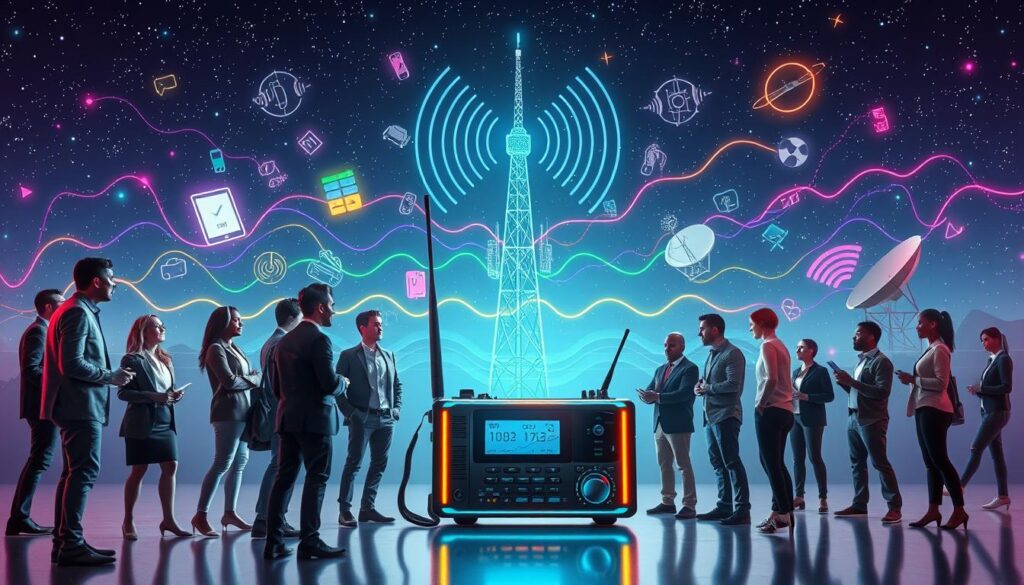
Amateur operators use HF to make direct contacts across states, oceans, and continents. Shortwave broadcasters transmit through roughly 3.95 to 25.82 MHz, allowing listeners to hear stations far from home when conditions support the path.
Citizens band radio offers a familiar example of practical band radio usage. It commonly works near 26 to 28 MHz and remains popular with truckers, travelers, and local groups.
Aviation, maritime, military, and government communication
Aircraft flying ocean routes use systems with frequencies that reach down to 2 MHz. The 2182 kHz channel serves as an international distress and calling channel.
Ships rely on HF and the Global Maritime Distress and Safety System for safety traffic. Military and government networks use standards such as MIL-STD-188-110C, with data rates up to 120 kilobits per second. STANAG 5066 adds reliable ARQ data exchange. Weather stations also use this band radio range for remote reports.
High Frequency Noise, Interference, and Signal Range
Clear reception depends on more than a strong transmitter. Unwanted electrical energy can cover a wanted signal, making speech harder to hear, data harder to decode, and connections less stable.
How electronic devices can disrupt HF signals
Broadband over power lines can leak energy into frequencies used for HF communication. Its operating range overlaps parts of the band, so nearby wiring may add noise to a receiver. Plasma televisions offer another real example. Their effect varies with the model, wiring, distance, and local signal conditions. Not every device creates the same problem.
Good antenna placement can help. A directional antenna can reduce unwanted signals arriving from the sides or rear. A remote site may also provide a lower noise floor, which improves weak-signal reception.
Interference is not the same as a propagation limit. Near the upper end of HF, groundwave service may reach only 10 to 20 miles. In that case, distance and signal behavior—not household noise—may explain the weak result.
- Check nearby electronics and power wiring.
- Rotate a directional antenna for a cleaner signal.
- Compare reception from urban and remote locations.
What People Mean by Being on a High Frequency
In everyday conversation, being on a high frequency means feeling positive, hopeful, calm, or energized. People use this phrase to describe an emotional lift, not a medical result or a promise of constant happiness. Supportive words such as “steady,” “grateful,” and “capable” can also shape the tone of a person’s day.
The connection to mood, energy, and positive feelings
High Frequency in Rensselaer, New York, uses this welcoming idea in its brand. The adult-use cannabis dispensary serves the Capital Region in a clean, relaxed, and inviting setting. Its selection includes flower, vapes, and edibles. The business presents these options for relief, creative afternoons, or winding down after work.
Why this everyday meaning differs from radio science
A personal mood is not part of the electromagnetic spectrum. A radio frequency has measurable cycles, wavelengths, and signal behavior. For example, “I feel calm after a walk” describes emotion, while an HF radio signal describes a technical transmission. The same word can fit both ideas, but the surrounding details show which meaning applies.
| Everyday use | Radio use | Clue |
|---|---|---|
| Positive mood | Measured signal | Personal feeling |
| Encouraging words | Wave behavior | Technical setting |
The Simple High Frequency Trick for a Better Day
A small morning choice can guide your attention without demanding a major lifestyle change. Pick one uplifting word, such as patient, focused, or open, and let it shape your intention.
Choose a word that feels useful
Keep the word practical. “Focused” may fit a busy workday, while “gentle” may help during a stressful morning. Write it on a note or say it quietly before you begin.
“I can handle the next step.”
Turn the idea into a brief routine
- Take one slow, deep breath.
- Repeat your chosen word.
- Think of one encouraging sentence.
- Take a small action that matches the mood.
Try this after waking, at lunch, or while winding down after work. High Frequency in Rensselaer also presents a clean, friendly setting for creative afternoons or everyday relief. This routine shifts attention and self-talk. It does not change the body’s scientific rate or the electromagnetic spectrum.
| Moment | Intention | Small action |
|---|---|---|
| Morning | Focused | Plan one task |
| Lunch | Open | Take a mindful pause |
| Evening | Calm | Put away one distraction |
High Frequency Examples, Sentences, and Key Takeaways
Here’s a quick glossary-style recap to keep both definitions clear. The radio band covers 3 to 30 MHz, with wavelengths from 100 to 10 meters. It sits within the electromagnetic spectrum and supports several useful frequencies.
Skywave propagation can carry signals beyond the horizon. Sunlight, seasons, and solar activity can change ionospheric conditions, so this band may work better at certain times.
One technical example sentence is: “Amateur radio operators use high frequency signals to contact stations across oceans.” Everyday example sentences sound different: “I use uplifting words to stay on a high frequency throughout the day.”
These examples show why context matters. The radio definition is measurable, while the mood-related definition is a personal expression and daily habit. Both definitions are useful when the surrounding sentences make the intended meaning clear.