
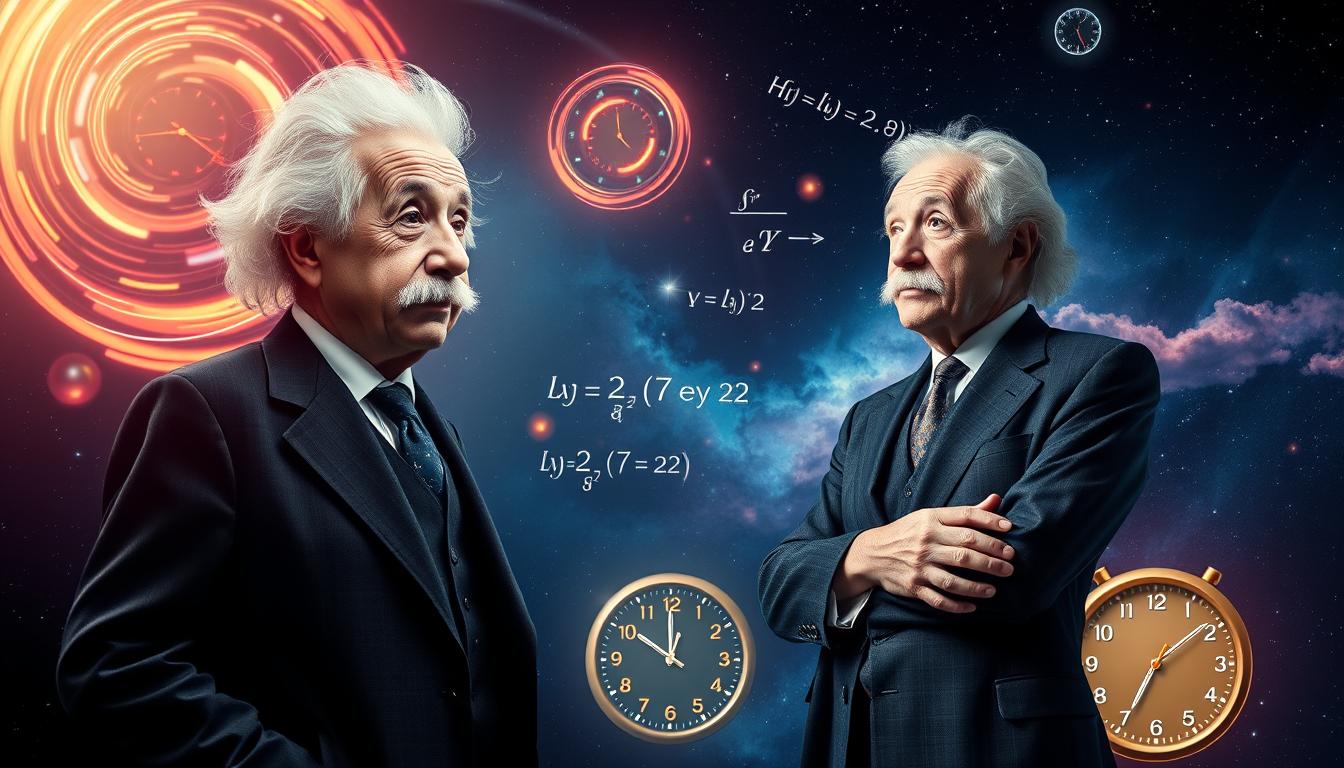
Can a physics idea help you handle a stressful day? It cannot fix every problem, but it can change how you see one. Albert Einstein lived from 1879 to 1955. He introduced special relativity in 1905 and general relativity in 1915.
His theory of relativity began with a simple challenge: first impressions may not tell the whole story. Time, distance, motion, and gravity can look different from another frame. That insight offers a useful guide for daily choices, tough talks, and moments when pressure clouds your judgment.
Einstein’s famous equation, E=mc², shows how a small formula can create a huge result. This article starts with real physics, then connects its ideas to flexible thinking. You will explore a practical point: changing your view can reveal new options without denying the facts. For background, read this DOE guide to relativity.
Key Takeaways
- Einstein’s work began in 1905 and expanded in 1915.
- Different frames can shape what people observe.
- Perspective can make hard problems easier to examine.
- E=mc² shows the power hidden in a simple equation.
- Relativistic ideas support calmer, more flexible decisions.
What the Law of Relativity Really Means
Relativity starts with a simple question: moving compared with what? For an observer, motion has meaning only beside a reference point. A train passenger may watch an adjacent train slide past and briefly think their own train has started moving.

Einstein’s first postulate says an observer can’t detect uniform motion without comparing it with another object. A body may move without a force causing that movement. Force changes speed or direction. Time and distance also depend on the frame used for measurement.
Why movement depends on the observer
Two observers can describe the same events in different ways and still follow consistent laws. Each observer uses a separate reference frame. The key point isn’t that facts become false; the viewing position changes.
How relativity differs from everyday assumptions
Newton’s theories work well at ordinary speeds. They become less accurate near light speed. Einstein’s theory keeps the laws of physics consistent under those conditions. This example offers a useful way to handle disagreements: check each viewpoint before judging.
- Compare movement with a clear reference point.
- Separate a body’s motion from the force acting on it.
- Remember that everyday theories have limits.
How Perspective Changes What You Measure
A reference frame turns a moving scene into something easier to measure. This idea supports relativity and works well in daily life. A car passenger can treat the car as still because nearby seats and windows keep the same position. Yet a roadside observer sees the car travel several miles.

Reference frames in cars, trains, and spaceships
Picture an astronaut bouncing a ball inside a ship. The ball rises and falls much like one tossed inside a room. The astronaut, ship, and ball share the same motion, so the basic result feels normal. An outside observer may measure the ship crossing space at a steady speed while the astronaut feels calm and still.
Why there is no absolute rest
Now imagine two ships gliding side by side at constant speed. Each observer can see the other ship move, yet neither can prove which ship holds the final position. Physics gives no universal marker for absolute rest.
This example also helps during conflict. Two people may describe the same events from honest positions. Changing an observer’s frame does not make every claim correct. It simply encourages a careful look at evidence, distance, and timing before reaching judgment.
Special Relativity and the Constant Speed of Light
Special relativity, proposed by Albert Einstein in 1905, rests on two postulates. Physics rules work the same for observers moving steadily. Each observer also measures the same speed of light in a vacuum, even when motion differs. Physicists widely accepted this theory by the 1920s.

Why Light Keeps One Measured Speed
A flashlight on a moving ship does not send light faster than a flashlight held on land. The measured speed stays constant. This strange result means space and time must adjust rather than change the speed of light.
How Space and Time Work Together
Scientists join three space dimensions with one time dimension in space-time. Distance and time can shift between observers, while the total pattern remains consistent. Matter cannot reach light speed because that result would require infinite energy.
What Time Dilation Means in Real Life
Imagine twins: one stays on Earth while another travels near light speed. The traveling twin ages more slowly, a measurable effect called time dilation. At everyday speed, this effect remains tiny.
“The clock you carry depends on the path you take through space-time.”
Daily stress does not follow a physical formula. Still, these ideas invite patience: a pause can change how much time feels available.
| Situation | Measured Time | Main Effect |
|---|---|---|
| Daily travel | Nearly equal | Too slow for notice |
| Fast spacecraft | Different | Time dilation |
| Light beam | Constant speed | Same measurement |
Mass, Energy, and Einstein’s Famous Equation
A tiny equation connects the stuff in your hand with the power inside stars. Einstein wrote it as E=mc². In this equation, E means energy, m means mass, and c means the speed of light. The square makes the number extremely large.

Mass measures how much matter a body contains. Weight differs because it measures gravity’s pull on that body. Your mass stays nearly the same on Earth or the Moon, but your weight changes.
The equation shows that mass and energy can change into each other. Inside the Sun, nuclear fusion joins two light nuclei into one heavier nucleus. Yet the new nucleus has slightly less mass than its starting parts. That missing mass becomes energy, which supports sunlight and heat.
- Mass: stored material in an object
- Energy: capacity to cause change or work
- Speed of light: a huge multiplier when squared
This result supports a key idea in physics and relativity, but it does not solve every personal problem. A compact equation explains nature; it cannot replace context, evidence, or careful choices.
General Relativity and the Shape of Space-Time
Special relativity studies steady travel. General relativity adds acceleration and gravity to the picture. Albert Einstein showed that mass can bend space time, while matter follows those curves. This theory treats gravity as more than a simple force between objects.
How mass curves space and time
Picture a heavy bowling ball resting on a trampoline. Its mass creates a deep dip. A smaller ball rolling nearby follows a curved path toward that dip. This image helps explain curved space time, but a trampoline cannot fully represent real physics. Actual space has three dimensions, plus time.
Why gravity changes motion
General relativity says gravity changes the path of a body through curved space time. Einstein’s equivalence principle adds a useful test: free fall can feel the same as uniform acceleration inside a rocket.
“A curved path can change the destination without changing the traveler.”
That line works as a life metaphor, not as scientific proof. A new viewpoint may reveal options, yet evidence must guide each choice.
| Idea | Physics Meaning | Practical Image |
|---|---|---|
| Mass | Bends space time | Bowling ball dip |
| Gravity | Shapes motion | Rolling ball path |
| Acceleration | Mimics free fall | Moving rocket |
What Black Holes, Stars, and Light Reveal
Some cosmic scenes show how gravity can reshape a beam without touching its source. This prediction from general relativity gives scientists a vivid view into space. A massive star can curve the path, change its direction, and alter its apparent distance.
Why gravity can bend light
During a solar eclipse, the Sun blocks the sky’s usual glare. Observers can then spot stars near its edge. Their light bends around the Sun before reaching Earth. This result helped confirm relativity and showed that gravity affects light, even though light has no rest mass.
How black holes trap light
A black hole packs huge mass into a small region. Its gravity grows so strong that an event horizon forms. Beyond this boundary, escape would require a speed greater than the speed light can reach. Light does not vanish; it remains trapped within that region.
This effect offers a careful life metaphor. A powerful situation may change what someone sees without changing every underlying fact. Pause, check the distance, and seek more than one direction before making a judgment.
Proof That Relativity Works in the Real World
Einstein’s predictions gained trust through tests that reach from Mercury to GPS. These results show that his theory describes measurable events, not just ideas on paper.
Mercury’s changing orbit
Mercury’s closest solar point shifts by an extra 43 seconds of arc each century. One second of arc equals 1/3,600 degree. Newtonian models could not fully explain this motion, but general relativity predicted the result.
Gravitational lensing and redshift
Gravity can bend light from distant stars and galaxies. This effect, called gravitational lensing, changes a beam’s direction. Gravitational redshift also changes wavelength when light moves through a strong gravitational field. Both phenomena match Einstein’s predictions.
Muons, accelerators, and GPS
Cosmic-ray muons usually last 2.2 microseconds. Earth observers measure a lifetime nearly 40 times longer because time dilation lets many reach the surface. A muon may travel about 16 miles, rather than 0.4 miles without this effect.
The U.S. Department of Energy uses particle accelerators to test matter near light speed. GPS satellites also adjust clock readings across different orbits. These practical results confirm that space, time, motion, and gravity work together in measurable ways.
Using Relativity to Reframe Everyday Problems
When pressure narrows your view, create a little mental distance. This physics idea, like relativity, helps you pause without denying your feelings. Take ten seconds and ask what you know, what you assume, and what needs more time.
Stepping back from a stressful situation
Einstein’s train example shows why first impressions can mislead. One observer may see a nearby train move. Another may feel their own train has started. Each frame uses nearby objects to measure motion, speed, and distance.
“Pause first. A wider view can reveal a better way forward.”
Separating facts from your viewpoint
Write the events in plain words. Then note the story your worried mind added. This simple exercise helps show what changes, what remains unclear, and which effects need evidence. It also keeps personal feelings separate from physical laws.
- Fact: A message arrived late.
- View: Someone chose to ignore you.
- Next step: Ask before judging.
GPS satellites offer a real reminder: different frames can affect timekeeping. A ship, body, or conversation may look different from another position. Check the facts two times before you react.
| Check | Helpful Question | Result |
|---|---|---|
| Events | What happened? | Clear record |
| Viewpoint | What did I add? | Less confusion |
| Next step | What can I verify? | Calmer action |
Where the Relativity Metaphor Has Limits
A helpful viewpoint can improve a choice, but it cannot rewrite nature. Relativity is a tested scientific theory, not a shortcut for solving every personal challenge.
At normal speed and in weak gravity, Newtonian physics and general relativity give almost identical results. Newton’s theories still guide cars, bridges, buildings, and many daily tools. Einstein expanded that picture for extreme settings, such as strong gravity or travel near light speed.
General relativity describes gravity through curved space-time. It does not instruct someone to change an attitude. A shift in viewpoint may change your response, yet it cannot alter physical time, remove a force, or turn an event in a new direction.
- Use perspective to check facts and assumptions.
- Do not treat a metaphor as medical, financial, or personal advice.
- Accept that some outcomes need action, support, or expert help.
The goal is a mental model, not an instant answer. A calmer view can support wiser action, but it cannot guarantee success or repair every relationship.
| Idea | What Physics Says | Useful Life Lesson |
|---|---|---|
| Time | Can vary by frame | Pause before reacting |
| Gravity | Shapes space-time | Context shapes choices |
| Perspective | Changes measurement | Check assumptions |
A New Way to See Life Through the Law of Relativity
Albert Einstein’s special and general theories show that time, space, motion, and gravity depend on each physical situation. The speed of light stays fixed, while clocks and distance can change for different observers. This is physics, not a slogan.
Evidence makes the point clear. Light from distant stars bends near mass. A light signal travels at the same speed, and light can lose energy near gravity. Another light beam may arrive at different times. These phenomena support the laws and produce a measurable result.
Daily problems need a simpler step. Put distance between an event and its meaning. Ask what happened, what you assumed, and what you can check. Another point may reveal a way forward, just as a ship or body can follow a different path through space.
This tested idea cannot solve every problem. Yet it can help you notice changes in time and perspective, check facts, and choose your next step with care.