

Planning a trip to Burning Man 2025 starts with one question: how much is burning man going to cost you this year?
The event runs Aug 24–Sep 1, 2025 (the Man burns Aug 30; the Temple burns Aug 31). Ticket tiers for 2025 list $550, $650, $750, $950, $1,500 and $3,000, and vehicle passes run $150. Official notes say producing the event in 2024 cost about $749 per person, with a breakeven ticket around $750.
This guide separates ticket price from the real-world costs that make most budgets: transportation, shelter, supplies, camp dues, and post-Burn cleanup. Expect wide variation based on setup, travel distance, and shared camp choices. The article uses a practical line-item breakdown so you can plug in your own choices and build a realistic budget.
Big budget levers include ticket timing, vehicle strategy, sleeping setup (RV vs hexayurt vs tent), and shared camp infrastructure. This piece focuses on US travelers but flags variables for international trips and stresses costs before, during, and after the event — especially cleanup. For context on living options and gear, see a quick primer on glamping vs camping.
Key Takeaways
- Ticket tiers vary; 2025 options start at $550 and go up to $3,000.
- Official 2024 production cost was about $749 per person; breakeven ~ $750.
- Major costs beyond tickets: travel, shelter, supplies, camp dues, cleanup.
- Your total price depends on choices like RV versus tent and vehicle plans.
- Plan early: buy key items ahead, share infrastructure, and budget post-Burn cleanup.
What Burning Man Costs Really Include in Black Rock City
Black Rock City functions like a short-lived municipality, and your budget should mirror that reality.
This event is not a typical festival. Venues don’t provide food stalls, water fountains, retail, or easy services. In Black Rock City you supply nearly everything for your experience.
That means your costs cover more than a ticket. Plan for shelter, water, food, transit, safety gear, and trash removal. These are city-level needs for a week in the desert.
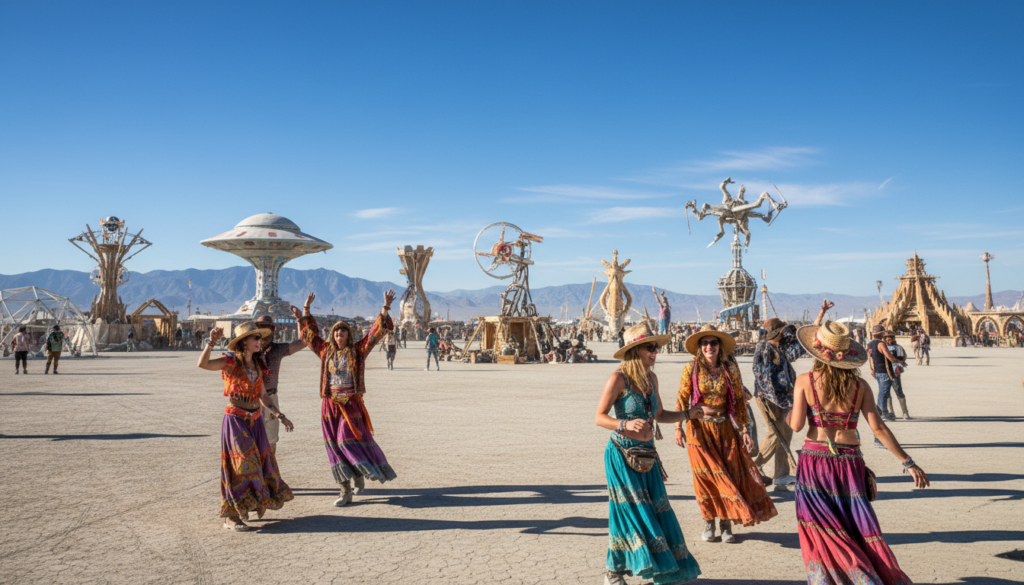
Radical self-reliance and what you must bring
Radical self-reliance saves money when you plan. Buying basics early is cheaper. Last-minute shopping on playa forces expensive fixes.
Only ice and coffee are sold on playa
If you forget sunscreen, masks, or full meals you can’t just swipe a card. Bring spares and don’t rely on others to supply your needs. The community gifts much, but don’t budget on being cared for by other people.
- Mandatory: tickets, vehicle pass
- Essential: water, food, shelter, bike
- Comfort: shade, AC, costumes, lighting
- Recovery: cleaning supplies, trash hauling
| Category | What it covers | Typical price range | Why it matters |
|---|---|---|---|
| Mandatory | Ticket & vehicle pass | $150–$3,000 | Entry and gate access |
| Essential | Water, food, shelter | $100–$800 | Survival for the week |
| Comfort | Shade, AC, generator, costumes | $50–$1,500 | Quality of daily life |
| Recovery | Trash, cleaning, vehicle wash | $30–$300 | Post-playa obligations |
First-timer surprises that raise expenses include shade needs, bike lights, and dust-proofing. Each upcoming section will break down a major cost bucket so you can budget by category.
For ideas on camp sleeping options and how that affects cost, see this bell tent sleepover guide: bell tent sleepover.
How Much Is Burning Man for Tickets and Vehicle Passes
Your upfront budget begins with tickets and a vehicle pass if you’ll drive into Black Rock.

Ticket tiers and listed prices
2025 ticket tiers listed at $550, $650, $750, $950, $1,500, and $3,000. Taxes and fees add to the sticker number, so plan for a small surcharge beyond the tier you pick.
Vehicle pass logic and cost-splitting
A vehicle pass sells for $150 per vehicle. One pass covers a single car, van, or RV.
- Per-person math: split a $150 pass across 2–5 people to lower individual expense.
- Tradeoff: more riders reduce cost but raise coordination and gear load.
Key sale windows and purchase limits
Major sale dates: Tomorrow Sale on April 30 at 12 PM PDT (prereg April 21–29) and the OMG Sale on July 30 at 12 PM PDT (prereg July 21–29). The OMG Sale included 3,000 tickets at $575 and 1,500 vehicle passes at $150 (taxes/fees apply).
“STEP remains open as an official exchange until Aug 24 at 12:00 PM PST for safe late purchases.”
| Item | Listed price | Notes |
|---|---|---|
| Standard ticket tiers | $550–$3,000 | Taxes/fees extra |
| Vehicle pass | $150 | One per vehicle; split with campmates |
| Historical example | $425 ticket / $100 pass | Prior-year context for expectations |
Purchase limits: max two tickets and one vehicle pass per transaction. This affects small camps and couples planning to buy for groups; plan purchases across trusted buyers.
Bottom line: entry costs are predictable. Your real budget swings from shelter, transport, and shared camp logistics. For tips on trimming travel fuel expense before the trip, see this guide to saving on gas: save on gas.
Ticket Strategy for First-Time Attendees
For first-timers, securing entry early removes the biggest uncertainty and unlocks every later decision.

Treat tickets as your priority. Once a ticket is secured, you can commit to RV deposits, camp dues, and travel plans without guesswork. Missing a sale often forces pricier, last-minute options for lodging and transit.
Main sales, last-chance windows, and STEP
Major sales are the best time to buy for predictable prices and availability. The OMG Sale on July 30, 2025 (prereg July 21–29) was the last large window before the event.
STEP is the official exchange for late purchases. It uses your Burner Profile and runs until Aug 24 at 12:00 PM PST. STEP is safer than random transfers, but inventory can vanish fast. Be ready to act quickly.
Purchase limits and planning for groups
Each transaction allows up to two tickets and one vehicle pass. Couples often coordinate purchases across accounts. Larger groups should assign multiple trusted buyers ahead of sale days.
- Create and verify your Burner Profile early.
- Preregister for major sales and note deadlines.
- Decide before purchase if you need a vehicle pass and plan splits.
- Once a ticket is locked, commit to deposits and shared costs.
“Ticket secured” is the signal to budget the rest — RV deposits, camp dues, and supply runs follow naturally.
| Sale type | When | Pros | Cons |
|---|---|---|---|
| Main sales | Early windows (spring/summer) | Better prices, higher availability | Requires preregistration and timing |
| OMG / last-chance | Late summer (example: July 30) | Final chance before STEP; some low-tier tickets | Limited quantities; higher pressure |
| STEP exchange | Until Aug 24, 12:00 PM PST | Secure, official transfers via Burner Profile | Inventory unpredictable; acts fast |
For a calm plan, treat securing a ticket as Phase One. If you need tips on trimming later costs once entry is locked, check this short guide to save on event services: save on event services.
Transportation to the Black Rock Desert and Getting to the Gate
Getting to the Black Rock Desert sets the tone for your whole trip. Where you fly and what vehicle you use affect fuel spend, time on the road, and the supplies you must carry. Plan transport early and factor it into your total cost.
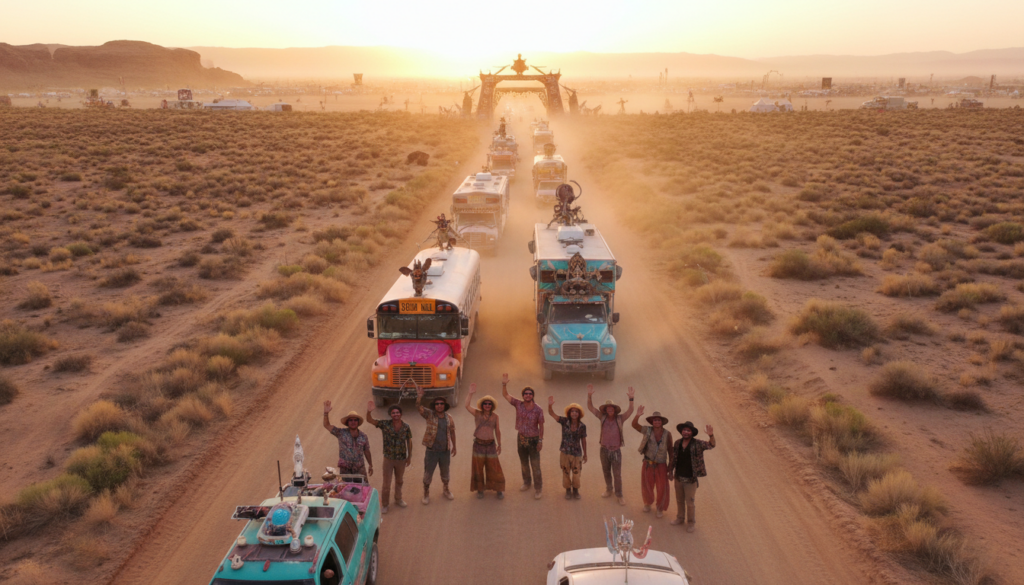
Fly-in hubs and final drive choices
Reno is the closest major airport: expect about a 2-hour drive to Black Rock City with normal traffic. That shorter leg usually means less gas, fewer hotel nights, and lower stress.
San Francisco and Los Angeles remain options when you need cheaper flights or an RV pickup. Sacramento sits roughly 4.5 hours away and can be a middle ground for some travelers.
Road trip costs to budget
Break transport into two decisions: flight city and ground vehicle. Choose a car, van, RV, or a rideshare arrangement with friends.
- Typical costs: gas, tolls, ice/cooler restocks, and pre-playa shopping for water and food.
- Plan an “errand day” before entry for bulk water, shade gear, and last-minute fixes; this saves pricey on-playa buys.
Timing arrival and departure to avoid bottlenecks
Gate queues and exodus congestion create hidden costs: extra fuel, snacks, and fatigue. Leaving the day after major burns can mean long delays.
Build buffer days into your schedule. Arrive with time to set up and shop. Give yourself an extra day after the event if possible.
| Choice | Drive time (approx.) | Cost factors |
|---|---|---|
| Reno → Black Rock City | ~2 hours | Lower gas, fewer hotels, quick final leg |
| Sacramento → Black Rock City | ~4.5 hours | Moderate gas, possible overnight, lower airfare some routes |
| San Francisco/Los Angeles → Black Rock City | 6+ hours (LA much longer) | Good flight options, RV pickup available, higher fuel/time cost |
Group coordination cuts per-person vehicle costs. Split gas and parking, combine supply runs, and assign shopping roles. Coordination reduces duplication and trims your final budget.
Where You’ll Sleep: RV vs Hexayurt vs Tent Cost Breakdown
Sleep setup is the comfort slider: luxury to budget, and each level has clear cost tradeoffs.
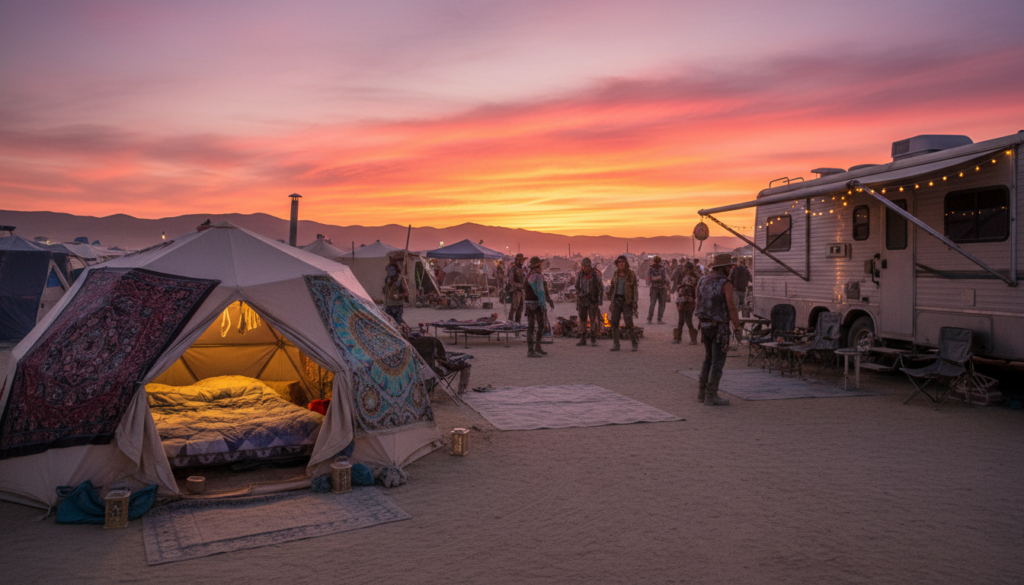
Luxury: RV rental and hidden fees
RV rental ranges commonly run $4,000–$9,000 for a week, depending on size and demand.
Expect extra charges: security deposits, surge pricing for event week, mileage limits, generator rules, and cleaning penalties for playa dust.
Mid-range: hexayurt, AC, and shared power
Hexayurts offer a practical middle path. A new unit often costs about $600; used units can be near $150.
Shared buys drop costs: a $333 yurt split three ways becomes $111 per person. AC units ($180 split) and extension leads ($20 split) cut perceived costs when camps pool gear.
Budget: tenting with shade
Tents are cheapest upfront but require good shade and dust protection to avoid extra spending on cooling or replacements.
Lack of shade drives impulse purchases and comfort upgrades. Plan a sturdy shade structure and covers to save money and improve rest.
“Better rest reduces impulse spending and improves safety and enjoyment.”
Post-Burn vehicle and cleanup costs
Dust creates tangible post-playa costs: expect about $65 for professional cleaning on rentals and roughly $20 for legal trash disposal while leaving the area.
Also budget time and funds for extra transport or temporary storage; these add to the final vehicle cost and affect re-entry day plans.
| Option | Typical upfront | Shared-cost examples | Key downside |
|---|---|---|---|
| RV | $4,000–$9,000 | Split fuel/park fees with campmates | High cleaning deposits, surge pricing |
| Hexayurt | $150–$600 | $111 yurt + $60 AC + $7 lead per person (example) | Needs generator access or camp power |
| Tent | $0–$300 | Shared shade structure lowers per-person cost | Poor cooling without shade; possible extra gear buys |
Bottom line: choose your sleep path against the full week experience. Better shelter reduces surprise buys, limits dust damage, and often pays back in comfort and safety.
Food, Water, and Survival Supplies: Your Real Weekly Burning Cost
Your week budget starts with food and water — the basics that shape every other decision on playa.
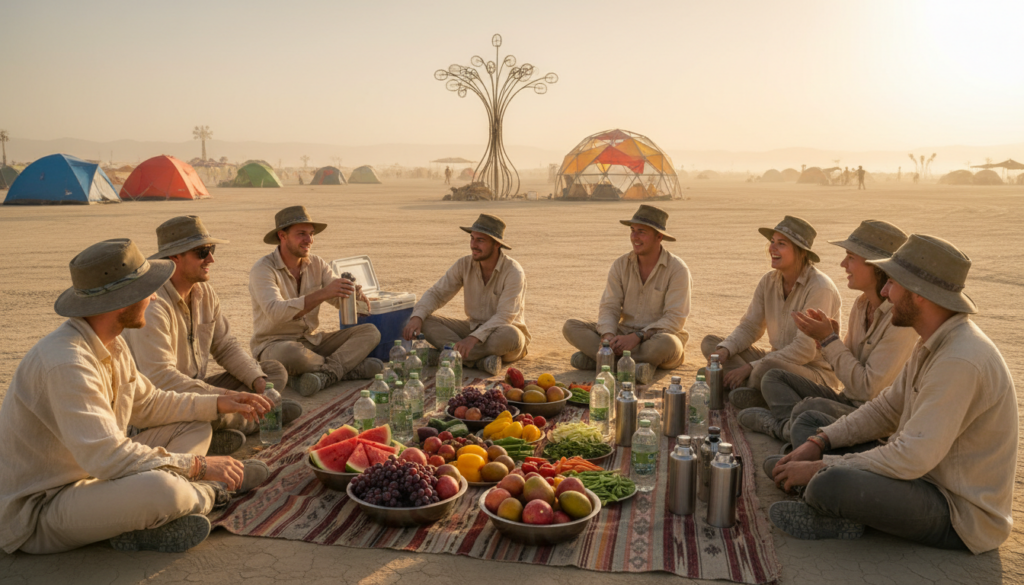
Water planning and its vehicle implications
Plan for at least one gallon per person per day for drinking, plus extra for cooking and washing. That changes what vehicle you need and how often you leave camp.
Tip: pre-fill sturdy containers and store them in shaded spots to avoid spoilage and repeated trips off-site.
Two food strategies
Minimal cooking: repeatable meals, canned proteins, and ready carbs. Low prep, low cooler dependency, lower costs.
Preference-driven: fresher items, more variety, and steady ice refills. Better taste but higher cooler and ice expenses.
Health, hygiene, and pharmacy runs
Wet wipes, hand sanitizer, lip balm, saline rinse, and dust masks are essential. Expect a small pharmacy run for blister care or allergy meds — budget about $30 for that.
Ice, coffee, and on-playa cash
Only ice and coffee sell for money on playa. Carry cash for convenience; set aside roughly $160 for ice, coffee, and emergencies.
- Essentials checklist: stove and fuel, cooler strategy, long-life snacks, electrolytes, backup meals.
- Wet wipes and dust protection prevent big bite-size expenses later.
- Combined food and water pickup for one traveler often totals near $150 before playa.
Self-reliance keeps you safe and prevents unplanned borrowing of community resources.
| Item | Typical single-person cost | Why it matters |
|---|---|---|
| Food + water pickup | $150 | Covers basic week supplies |
| Pharmacy/first aid | $30 | Last-minute health needs |
| Ice/coffee cash | $160 | On-playa purchases and emergencies |
Glamping packing tips can help refine your cooler and shade choices for a better overall experience in Black Rock City.
Camp Dues, Shared Infrastructure, and Community Costs
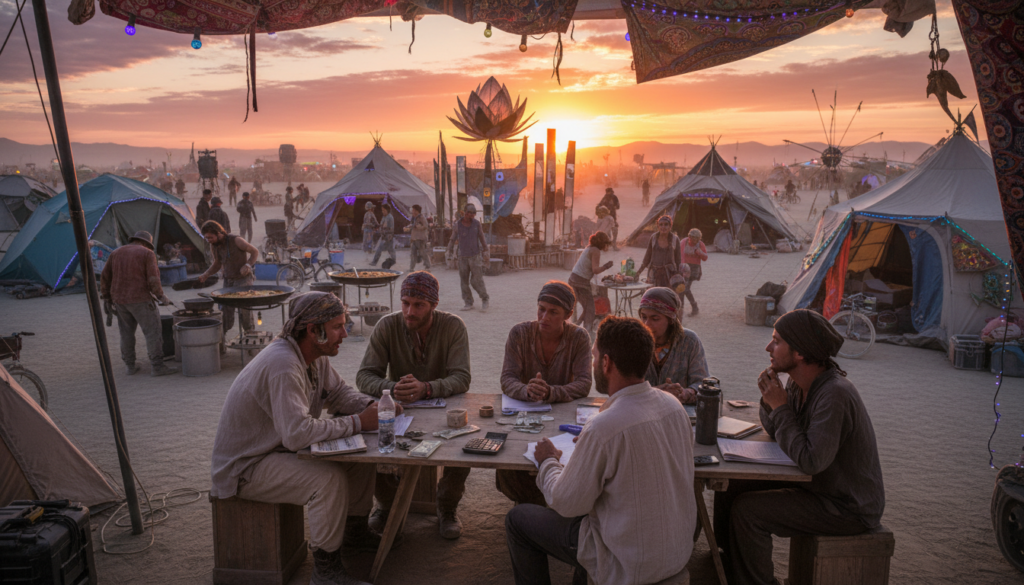
Joining a camp changes the equation for your week on the playa. Camp dues act like a membership fee that funds shared shade, power, water systems, kitchens, showers, gray-water handling, and interactive features. They reduce solo logistics but add an upfront cost you should vet before committing.
What camp dues typically cover — and what they don’t
Covered: communal shade structures, generator rental, group kitchens, showers, medical supplies, trash hauling, and storage/transport logistics.
Not covered: personal shelter, most food and water, individual costumes, and some personal power needs. Ask a camp for a clear itemized list before you pay.
When “big camp” means six-figure infrastructure
Large groups (150+ people) run complex builds. Generators, trucks, shaded geodesic domes, staged bars, sound rigs, and even portable showers add up fast. Fundraisers and dues often push total camp spend near six figures for a full setup and logistics chain.
An example couple’s week-plus budget
| Item | Approx cost |
|---|---|
| Two tickets + one vehicle pass | $1,500 |
| Camp dues (per person) | $500 |
| RV rental | $4,000–$9,000 |
| Food, water, supplies | $1,500 |
| Outfits for two | $1,500 |
This sample hits roughly $8,000 and shows how quickly costs add up when RV and wardrobe choices enter the plan.
Participation, gifting, and not being a “sparkle pony”
Gifting can be small and meaningful: volunteer time, share a meal, or maintain a shade structure. Don’t be a sparkle pony — under-packing forces camps and people to cover your basics. Bring your essentials and check what the camp expects you to supply.
Checklist before you commit: ask what dues include, whether shifts or work parties are required, how funds are handled, and what gear remains your responsibility. If you prefer fewer logistics, a structured camp with higher dues can simplify the experience.
For group options that blend comfort and lower per-person load, consider exploring nearby glamping guides like beach glamping to compare shared infrastructure models.
Conclusion
Closing thought: a ticket starts the plan, but transport and shelter drive the final total. Build a strong, simple plan that layers costs in order.
Smart budgeting order: lock tickets and a vehicle plan, choose your sleep setup, then map water, food, and supplies. Finish with camp dues and extras.
Start early — buying in good time lowers prices, frees choices, and avoids expensive last-minute fixes. In your final days confirm water and food counts, verify lighting and dust protection, and plan for cleanup and trash.
Remember: Burning Man is not a typical festival; you are creating a short-lived city in the desert. Match spending to goals — comfort, shared mid-range, or lean — and use this article to build your line-item budget for the year you’re attending.
For shelter options and shared setups, see glamping options.