
Facing a major housing choice can feel heavy. This short guide breaks down the financial and lifestyle factors that matter right now.
Start by checking your budget. Review monthly mortgage payments, insurance, taxes, and maintenance. A reliable calculator and current market data give quick clarity on whether rent buy makes sense for your situation.
Think about time and long-term goals. Buying a home can build equity and lock in value over years. But upfront costs, interest, and price trends affect the final outcome.
Use tools and local research before you commit. For practical saving tips and a planning checklist, see this short guide on how to save for a home: save for a home.
Key Takeaways
- Compare monthly payments and total costs, not just rent versus buy numbers.
- Factor in insurance, taxes, and maintenance when planning your budget.
- Use a rent buy calculator and local market data for realistic estimates.
- Buying builds equity, but upfront fees and interest change the math.
- Match your choice to your time horizon and personal situation.
Understanding How to Decide Between Renting and Buying a House
A quick calculation can reveal whether monthly costs favor staying put or owning. Start with a rent buy calculator like Fidelity’s to model mortgage, taxes, insurance, and upkeep. Local numbers make the result relevant for your city.
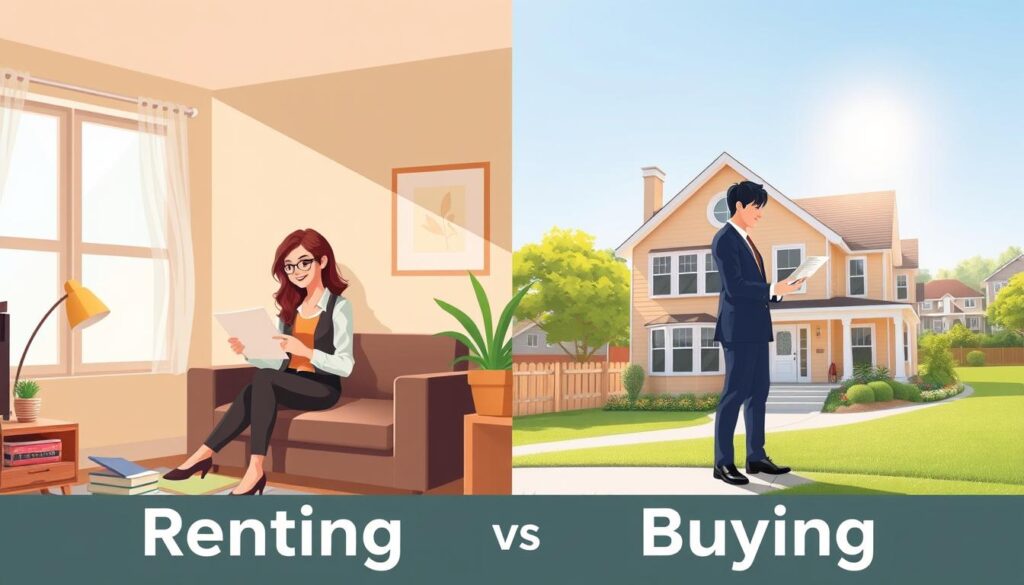
The price-to-rent ratio is another simple metric. It shows whether current market values make ownership a good value compared with local rent levels.
Think about lifestyle, too. Flexibility from renting can suit short-term plans. Stability from owning often fits long-term goals and wealth building.
- Use a calculator to compare monthly costs and long-term totals.
- Watch local rent and house price trends when evaluating your option.
- Match the rent buy comparison with financial goals and personal needs.
Practical tip: If you need a savings checklist before making a move, see this guide to save for a home.
Evaluating Your Current Financial Standing
Begin with a snapshot of your money: income, debts, and regular payments.

Check savings against typical down payment ranges. NerdWallet notes a median first-time down payment of 9%. Fidelity reports 20% usually avoids private mortgage insurance on a conventional mortgage.
Estimate the amount you can reasonably set aside without draining emergency funds.
The Role of Your Credit Score
A strong credit score lowers mortgage rates and reduces total interest paid over time. Lenders also look at your debt-to-income ratio; keep total monthly debt under about 36% of pretax income when applying for a loan.
- Use a mortgage calculator to model monthly payments, insurance, taxes, and maintenance.
- Compare current rent payments with projected mortgage payments and closing costs.
- Factor equity growth against upfront amounts and ongoing costs.
Practical step: Run numbers and review a savings checklist at ways to save on rent to improve your financial situation before you buy home property.
Analyzing Local Real Estate Market Trends
Comparing nearby sale prices and current rents reveals real market signals.

The price-to-rent ratio is a quick measure. Divide a home’s purchase price by the annual rent for a similar property. A ratio above 20 usually favors rent; below 20 often favors buying.
Local supply, recent sales, and rental demand shape value. Use a city-level calculator and cost tools when you compare places. NerdWallet’s calculators can help with city comparisons.
- Check recent listings and rent ads for realistic figures.
- Watch vacancy rates and new construction activity.
- Factor local taxes and typical maintenance costs into your math.
| Metric | What It Shows | Quick Action |
|---|---|---|
| Price-to-Rent | Buy vs rent signal | Compute with local figures |
| Inventory | Supply tightness | Expect higher price growth |
| Rent Growth | Demand pressure | Compare with mortgage change |
Practical link: For savings ideas that affect the buy home timeline, check this short guide on long-term cost savings: saving on home costs.
Comparing the True Costs of Ownership
Small recurring bills add up fast; an honest tally shows what ownership truly costs.
Start with maintenance. Experts place annual repair budgets between 0.5% and 1.5% of home value. Use the higher figure for older houses and the lower for new builds.
Maintenance and Repair Estimates
Plan routine upkeep and surprise fixes. Fidelity suggests 0.5% per year; NerdWallet recommends up to 1.5% for a conservative buffer.
Property Taxes and Insurance
Property taxes and homeowners insurance join mortgage payments as ongoing expenses. Local tax rates vary, so check your county assessor’s data when estimating yearly outlays.
Closing Costs and Fees
NerdWallet now estimates closing costs near 6% of purchase price after recent industry changes. That can add thousands at closing and should appear in your upfront budget.
“Mortgage payments are just one part of total costs; insurance, taxes, and maintenance shape long-term value.”
- Set aside annual maintenance equal to at least 0.5% of value; use 1.5% if uncertain.
- Factor property taxes, homeowners insurance, and mortgage interest in your monthly payment math.
- Remember closing costs can reach roughly 6% of the purchase amount.

| Cost Item | Typical Rate | How to Estimate | Impact |
|---|---|---|---|
| Maintenance & Repairs | 0.5%–1.5% per year | Home value × rate | Adjusts annual cash flow |
| Closing Costs | ~6% one-time | Purchase price × 6% | Raises upfront cash needed |
| Property Taxes & Insurance | Varies by area | Local tax rate + insurer quote | Affects monthly payments |
Tax note: You may itemize mortgage interest deductions if total deductions top the 2025 standard deduction ($15,000 single; $30,000 married filing jointly). Use a calculator when modeling mortgage interest and payments to see if itemizing helps.
Practical link: For related savings that affect your wider budget, check car insurance tips at car insurance savings.
Lifestyle Factors That Influence Your Choice
Lifestyle needs often tip the balance when choosing where you’ll live next.

Mobility matters. Renters can move at lease end with less hassle. Owners must plan time and money for selling if they relocate.
Control matters, too. When owning home property you can renovate and personalize freely. Rentals often limit big changes.
Predictability is another factor. A fixed-rate mortgage locks monthly payment amounts, while rent may rise each year.
“Your choice is about time, pride, and who handles upkeep.”
- Flexibility: Easier when renting; harder when selling a property.
- Design freedom: Greater when owning home property; restricted in many leases.
- Ongoing costs: Owners cover maintenance, insurance, and property taxes; renters usually do not.
- Long-term money: Ownership builds equity but requires upfront cash and steady mortgage payments.
| Factor | Rent | Own |
|---|---|---|
| Flexibility | High — move at lease end | Low — selling takes time and fees |
| Design Control | Limited — landlord rules apply | Full — remodel and update freely |
| Cost Predictability | Variable — rent increases possible | Stable with fixed-rate mortgage |
| Maintenance | Mostly landlord responsibility | Owner pays repairs and upkeep |
Run numbers with a calculator and review lifestyle priorities before choosing an option. For quick savings ideas that free up money for either path, see this quick savings guide.
Long Term Wealth Building Strategies
A patient approach often converts monthly payments into tangible wealth over years.

The impact of equity grows with time. As you make regular mortgage payments more of each payment moves toward principal. That shift raises the owner’s equity share and reduces outstanding debt.
Equity is both a cushion and a resource. Over many years it can fund renovations, an investment, or down payment on another property.
The Impact of Home Equity
Build equity deliberately. Stay current with mortgage payments and keep the property well maintained. Market value gains also raise equity, but steady payments are the reliable factor.
- Make timely mortgage payments to increase principal ownership.
- If you choose renting, invest the savings from skipped down payment and upkeep into a diversified portfolio.
- Mortgage interest may offer tax deductions in some years; include that when modeling long-term value.
“Building equity is a slow, steady marathon that rewards time and consistent payments.”
Final Thoughts on Your Housing Future
, Finish with a clear view of cash flow, future moves, and personal needs. Check your financial situation and confirm whether buying home fits your timeline and goals.
Use a calculator to model mortgage payments, property taxes, insurance, and maintenance so total costs are visible. For budgeting tips that support this step, see budget and save money.
If you expect to move in under three years, owning home may not match your plan. Weigh market trends, personal preferences, and long-term growth before any purchase. Clear math and honest priorities make the final decision easier and more confident for your housing future.