
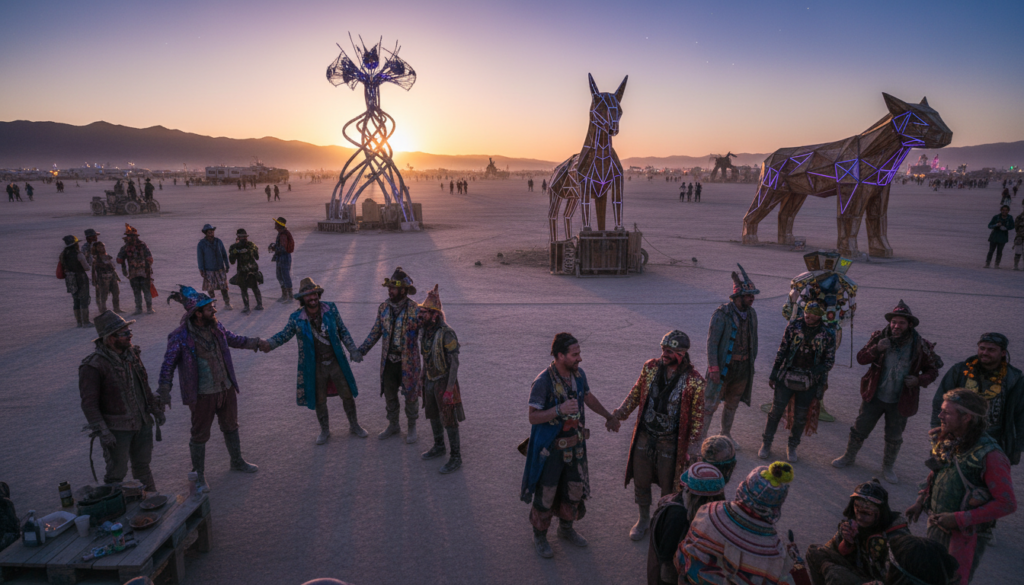
This articleopens with a clear view of an unusual week-long desert city built by volunteers and participants.
The event centers on community, large-scale art, shared rituals, and hands-on participation rather than staged concerts. Visitors live in a temporary city, trade gifts, and join creative projects.
Expect interactive installations, roaming sound camps, late-night creativity, and bold costume culture. The social code values self-reliance, safety, and leaving no trace.
This guidepreviews when and where the week happens, how days flow, and why Black Rock City feels different from other gatherings. It also flags evolving rules, tech, and resilience planning after harsh weather.
Ideal readers include curious newcomers, returning participants, and researchers of US counterculture. Later sections unpack core principles, survival planning, legal realities, and the emotional pull of the burns.
Key Takeaways
- Think of the event as an art-and-community experiment, not a typical music show.
- Participation beats spectating; bring supplies and ideas.
- Black Rock City is temporary, intense, and regulated.
- Expect interactive art, nightlife camps, gifting, and strong rituals.
- This article will cover principles, safety, costs, and practical planning.
What Is Burning Man and Why People Call It a Festival
For one week near Labor Day, an improvised city rises on the playa and becomes a living art project. This week-long gathering blends art, self-expression, and practical self-reliance into a single shared experience.
At its core, the gathering functions as both a festival and a cultural experiment. Many call it a festival because of large-scale art, late-night activity, and collective celebration. Yet it goes further: thousands co-create Black Rock City together, running services, camps, and shows without traditional promoters.
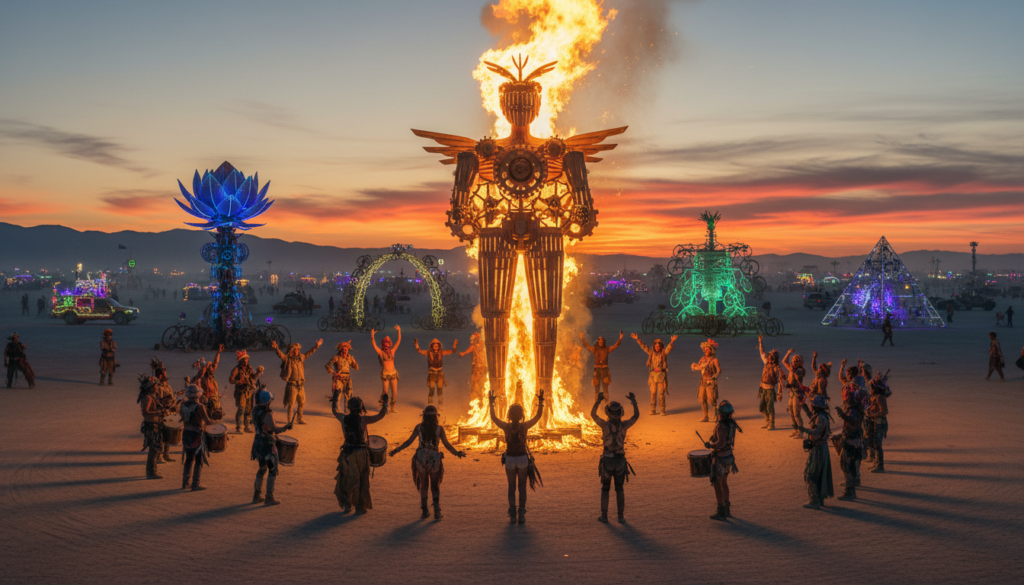
The ritual highlight is the ceremonial burning of the wooden effigy known as the Man, usually on the Saturday before Labor Day. That burn acts as a shared moment of release and renewal for people who helped build the city.
“Community forms when strangers bring skills, supplies, and care to make something temporary and meaningful.”
- Timing: plan months ahead for tickets, gear, and logistics.
- Self-reliance: bring water, shade, food, and basic first aid.
- Participation: contribute to camps, art, or volunteer roles to truly belong.
What is a burning man festival in the Future: The Core Idea Explained
In future editions, the core appeal will keep evolving because participants build most of the event’s moments. This type of gathering relies on contribution rather than commercial programming.
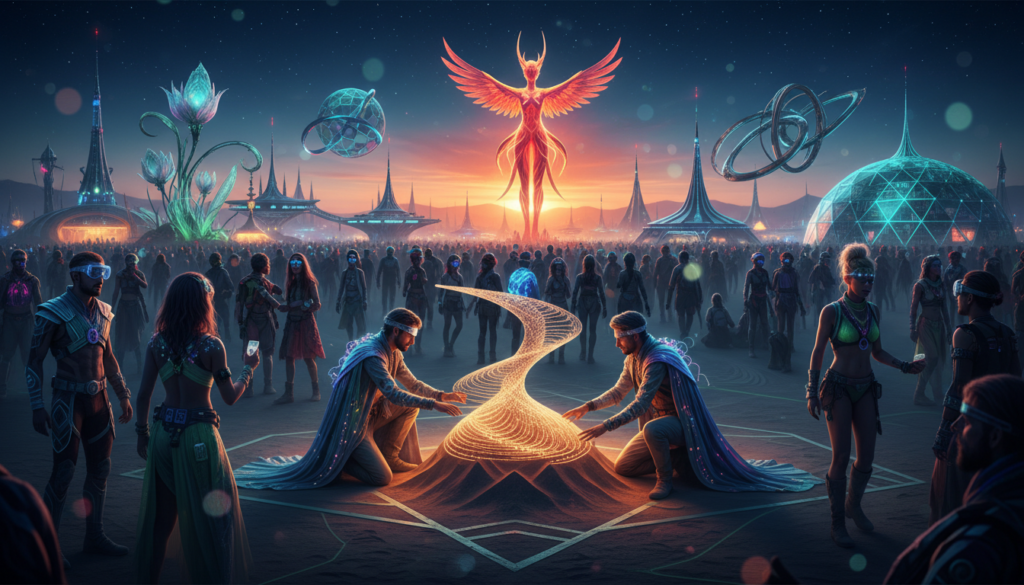
Participation over spectatorship
No headliners means there is no central, ticketed lineup. You will still find amazing music and shows, but they appear across camps and pop-up stages.
Thousands of people host workshops, run sound systems, or create art installations. The result is a mosaic of micro-events all happening at once.
How themes shape art and camps
Each year, an official theme guides artists and camps. Themes steer visual language, camp concepts, costumes, and city-wide storytelling.
Expect motifs to repeat across installations. Themes give cohesion without replacing open-ended creativity.
- On the ground: volunteer roles, building projects, and shared meals form the backbone.
- For newcomers: adopt a contributor mindset to get more from the experience.
- Planning impact: participation affects rules, gifting habits, and safety planning.
| Feature | How it Shows Up | Why it Matters |
|---|---|---|
| No headliners | Pop-up performances, sound camps, DIY stages | Keeps the city decentralized and driven by participants |
| Annual theme | Art prompts, camp designs, costume trends | Provides a creative frame each year without strict rules |
| Participation | Building art, teaching workshops, gifting services | Transforms attendees into co-creators of the city |
Where Burning Man Happens: Black Rock Desert, Nevada
Black Rock City sits on a vast dry lakebed in northwest Nevada, and the place shapes nearly every part of the experience.
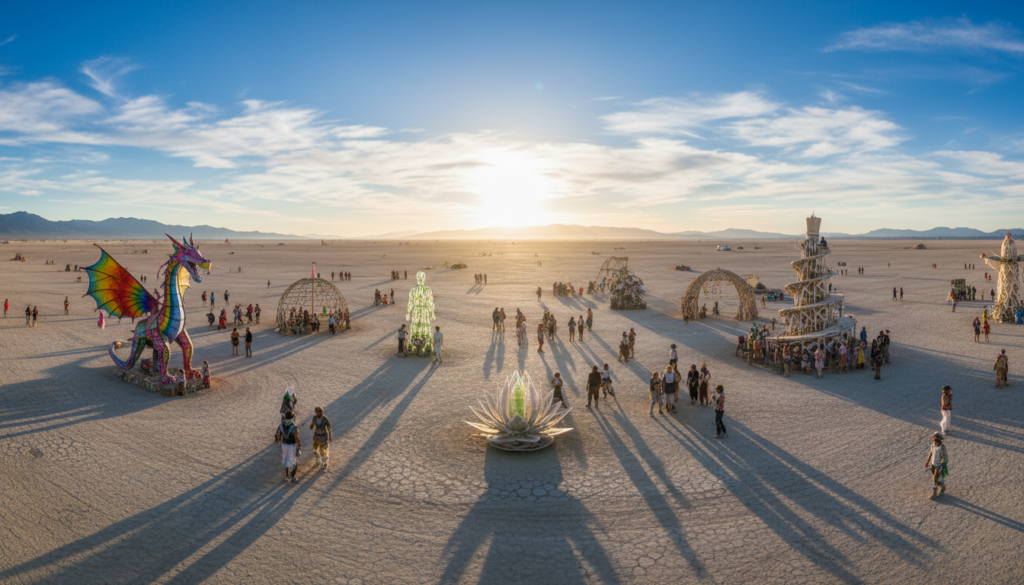
Black Rock City on the playa in Pershing County
The event takes place on the playa — a flat, alkaline dry lakebed. This surface affects navigation, art placement, and dust risks.
How remote it is
The site is roughly 141 miles (227 km) north of Reno. Services are limited, so many route through Reno for supplies and last-minute gear.
Coordinates and jurisdiction
Coordinates: 40.7869°N, -119.2042°W. The location sits in Pershing County, which matters for permits, emergency response, and law enforcement.
“Wide-open desert, vast sky, and loose regulations on scale let artists build pieces impossible in cities.”
| Feature | Detail | Why it matters |
|---|---|---|
| Place | Black Rock Desert playa | Flat surface for large installations and clear sightlines |
| Distance | ~141 miles north of Reno | Limited services; plan for supplies and fuel |
| Jurisdiction | Pershing County, Nevada | Permits, emergency services, and legal oversight |
- Practical tip: pack water, shade, and navigation tools before leaving Reno.
- Experience: the nevada desert setting creates vast skies and intense dust that shape the culture.
When Burning Man Takes Place and How the Week Flows
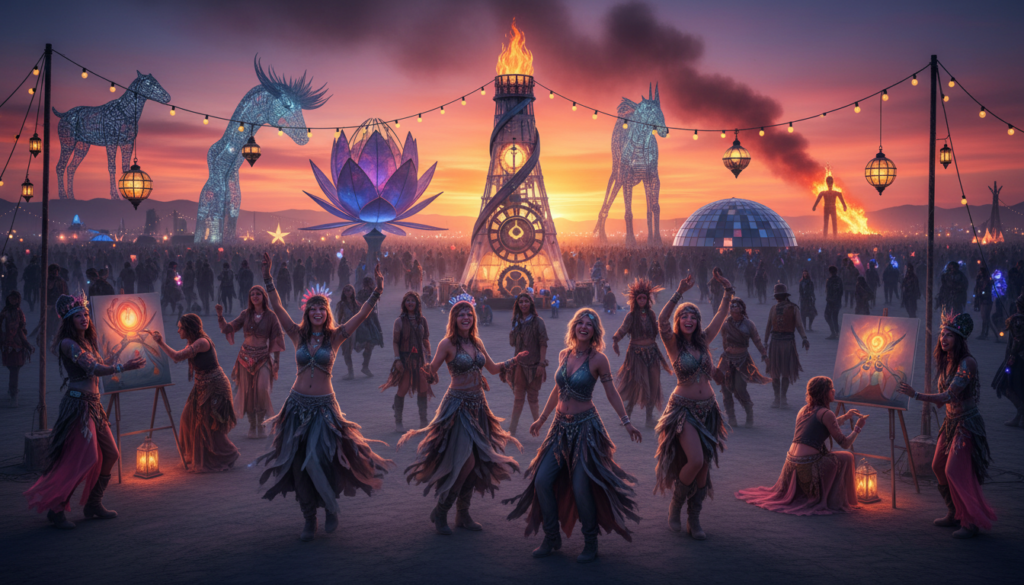
Late August brings a predictable rhythm: setup, exploration, and ritual that builds toward two intense nights. The core calendar anchor is simple. The gathering generally runs in late August through Labor Day and spans nine days.
Timing and weekly pattern
Arrival and build days focus on camp setup, art installs, and getting supplies in order. Midweek shifts to exploration, workshops, and camp programming.
As the week advances, activity peaks. The weekend brings the two major burns and city-wide celebrations.
Key nights: structure and tone
Man burn: usually the Saturday before Labor Day. It’s high-energy, communal, and loud. Expect crowds and fireworks.
Temple burn: follows later and feels quiet and reflective. Many use this night for private rituals and mourning.
- Check official channels: weather, access, and permits can shift exact time and routes.
- Future-focused tip: plan for heat, dust, or rain so you can adapt without panic.
- Pace yourself: rest and hydration keep the full event experience sustainable.
From Baker Beach San Francisco to Black Rock City: A Short History
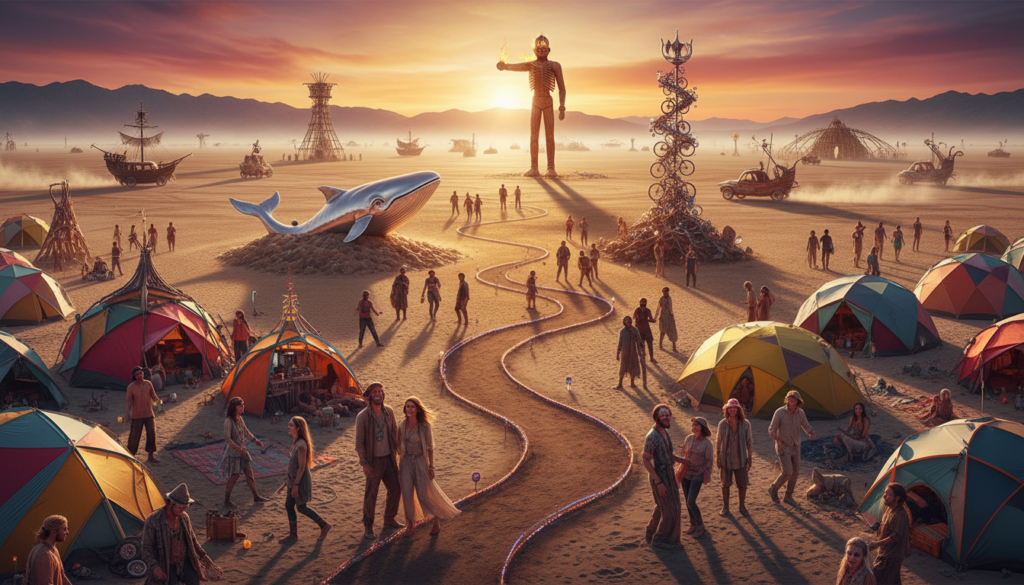
A humble summer solstice ritual on Baker Beach San Francisco began an unlikely cultural experiment. On June 22, 1986, Larry Harvey and Jerry James built an 8-foot wooden effigy and burned it with friends.
The beach gathering stayed small for several years. By 1990, the group needed more space. The first desert burn during “Zone Trip No. 4” moved the event to Nevada and set the stage for modern Black Rock City.
Early steps and rapid growth
The shift to the playa mattered because the desert offered scale and fewer city constraints. Over the years the project grew from a circle of friends into tens of thousands people by recent decades.
Growth also brought new rules, more infrastructure, and harder logistics. In 2019, official attendance reached 78,850 people, showing how far the experiment had stretched.
“From an 8-foot effigy on a beach to a planned temporary city, the history explains why systems and principles now exist.”
- 1986: inaugural Baker Beach ritual led by Larry Harvey.
- 1990: first Black Rock Desert site burn, birth of modern form.
- 2019: 78,850 official participants, scaling debates follow.
| Year | Event | Significance |
|---|---|---|
| 1986 | Baker Beach burn | First effigy (8 ft) by Larry Harvey; grassroots origin in San Francisco |
| 1990 | Zone Trip No. 4 | Move to Black Rock Desert; space for large installations |
| 2019 | Major attendance | 78,850 official participants; debates over scale and culture |
Founders and the Organization Behind the Event
Three Bay Area figures and a prankster network planted the seeds for the modern gathering.
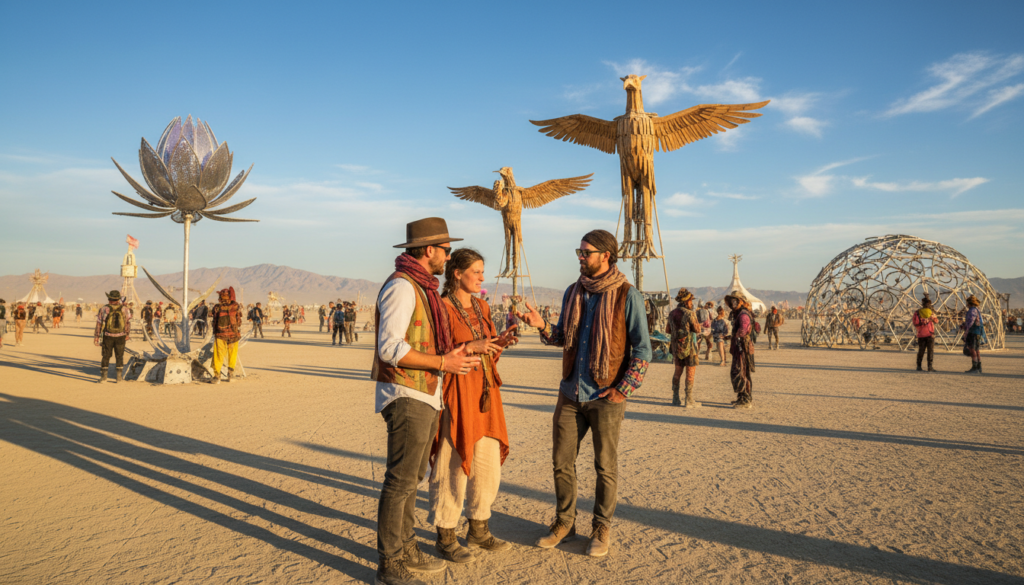
Larry Harvey, Jerry James, and John Law came from street theater, art, and do‑it‑yourself culture. They mixed small rituals with public stunts and invited friends to join. The Cacophony Society played a key role by teaching playful disruption and experimental community building.
From prank crew to nonprofit
The event eventually required permits, logistics, and year‑round work. In 2013 Black Rock City LLC shifted stewardship to the Burning Man Project, a nonprofit focused on mission-driven care of the city and its art.
That change meant professional planning for safety, permitting, and on‑playa services like BMIR for urgent updates.
“Community stewardship grew out of play and became serious work to protect the project.”
- For rules and tickets: refer to burningman.org for official details and updates.
- For practical prep: check community guides and packing advice, such as this glamping packing guide.
The Ten Principles That Shape Life on the Playa
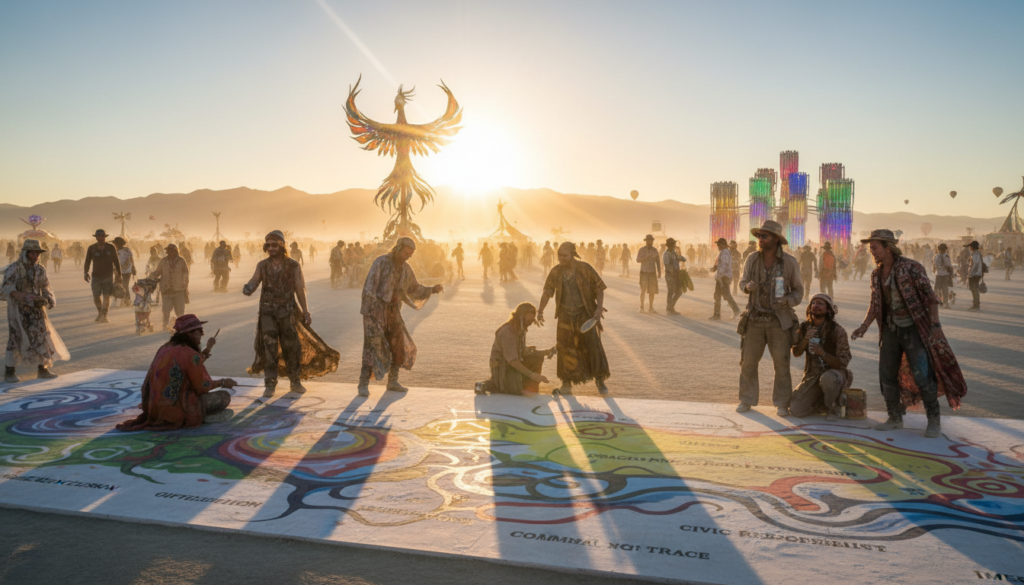
Ten guiding maxims steer daily life on the playa and shape how people share space and care for the environment.
Radical inclusion: everyone who arrives and joins with respect can find community. Newcomers and longtime participants meet through shared work and simple invitations.
Gifting: gifts bind people. A chilled drink, a workshop, or a small favor builds trust. Gifts are given freely, not used for advertising or gain.
Decommodification: no corporate signage or sales-driven stalls. This keeps the experience human and slows the rush of brands into public life.
Radical self-reliance: bring water, shelter, and gear. Expect to solve small problems and help others do the same.
Radical self-expression: create boldly, but seek consent and consider impact. Your art is yours; your actions affect people nearby.
- Communal effort & civic responsibility: volunteer, share skills, follow safety norms, and step in when someone needs help.
- Leaving no trace: pack out everything. The desert must look like nothing happened when people leave.
- Participation: show up actively—help build, run, or teach to make the city real.
- Immediacy: be present. The richness comes from living events in real time, not recording them for later.
| Principle | Practical action | Why it matters |
|---|---|---|
| Radical inclusion | Invite others, welcome questions | Builds a diverse, resilient community |
| Gifting | Share goods or skills without strings | Creates social ties, not transactions |
| Leaving no trace | Clean camp, remove debris | Protects fragile desert environment |
Gifting and Decommodification: How the “No Advertising” Culture Works
A culture of giving replaces shopping, making camps the main hubs for shared goods and experiences.
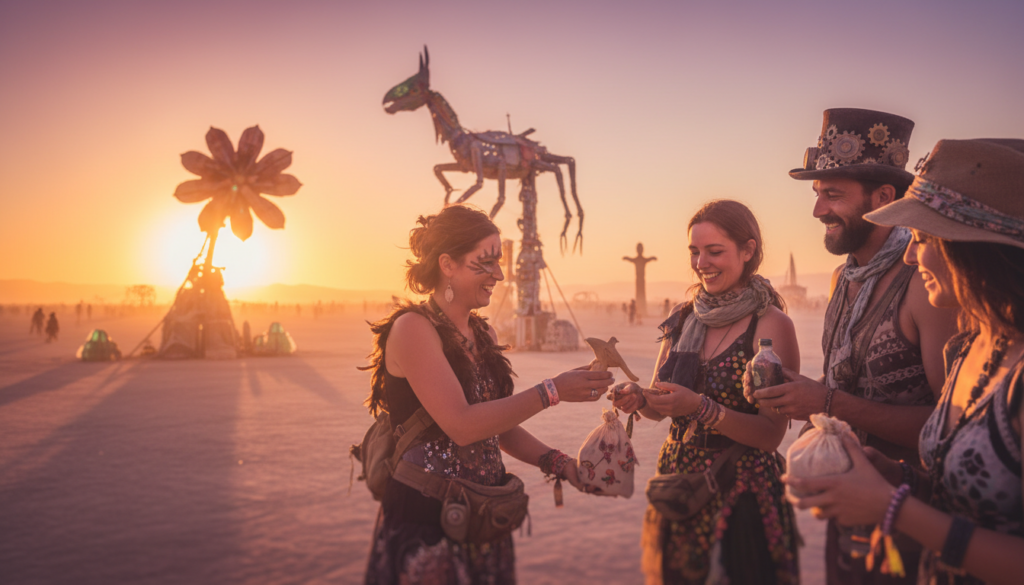
Gift economy, plain and simple: most things you receive are gifts. Your role is to contribute skills, time, or supplies rather than expect purchasing options. Camps run on volunteers who offer food, repairs, and workshops freely.
What you can and can’t buy
Full commercial vending is not allowed. The notable practical exceptions many people rely on are coffee and ice, which are often sold for convenience.
Beyond that, expect gifting, not retail. Do not plan on storefront-style services across the place.
How camps share goods and services
Examples are easy to spot: free meals, mocktails, bike repair stations, yoga classes, haircuts, art tours, and late-night grilled cheese runs.
These actions create the communal feel and keep the experience non‑transactional.
Decommodification for brands and creators
On the ground: no banners, no brand activations, no sales pitches, no coupons. That rule preserves the participatory spirit and blocks overt advertising.
“Treat moments and people with care—ask before filming, credit artists, and avoid logos or promotion.”
Content creators must respect consent, avoid turning people into props, and keep promotion off playa. As the event gains online visibility, protecting this non-commercial culture matters more.
- Etiquette: ask permission before photographing or recording.
- Credit: name artists and camps when sharing work.
- Contribute: bring something to offer instead of just consuming.
Art at Burning Man: Installations, Fire, and Interactive Experiences
Massive sculptures and delicate installations share the playa, inviting hands-on exploration at every turn.
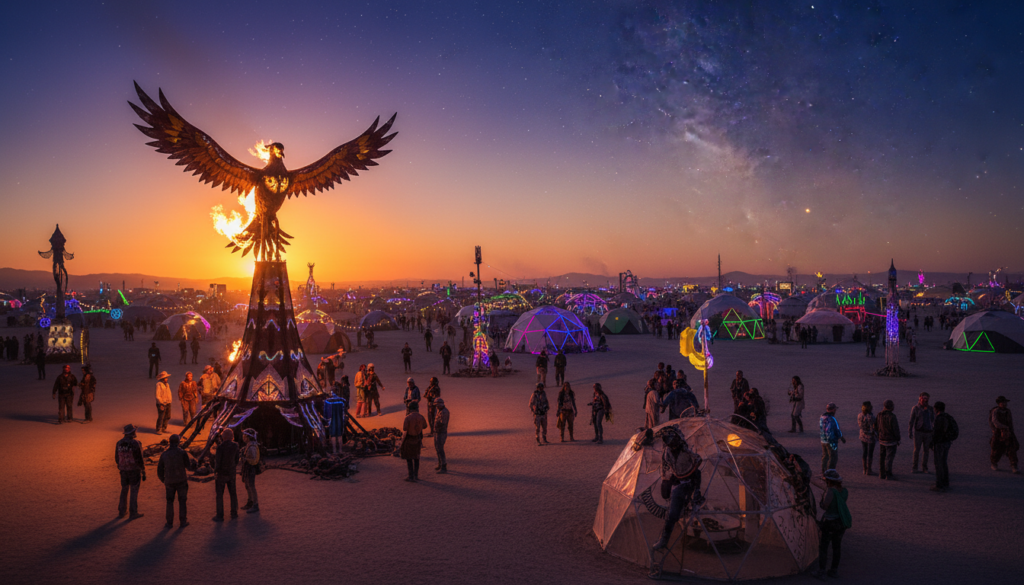
Large-scale sculptures, buildings, and experimental structures
Work ranges from small kinetic pieces to monumental structures you can climb or walk through.
Many works combine light, sound, and movement. Some require pushing, pedaling, or stepping inside to complete the piece.
Fire art and burn platforms
Fire elements are powerful but tightly managed. Burns follow permits and safety plans.
Burn platforms and controlled zones protect the playa and help enforce leaving no trace.
The Temple as ritual space
The Temple carries a quieter tone than the Man burn. It serves for reflection, grief, and gratitude.
Participation in the Temple is often solemn; users ask for privacy and care when documenting moments there.
- Look by day for texture and scale; by night for illuminated detail and surprise.
- Interactive pieces reward touch, sound, or collaboration — they shape the shared experience.
- Respect rules around photography; Temple spaces usually have stricter norms.
“Art here asks you to act, not just observe.”
Music and Nightlife Without a Traditional Lineup
Nighttime across Black Rock City pulses with DIY sounds, surprise sets, and hidden dance floors waiting to be found. There’s no main bill; instead, music appears when you seek it.
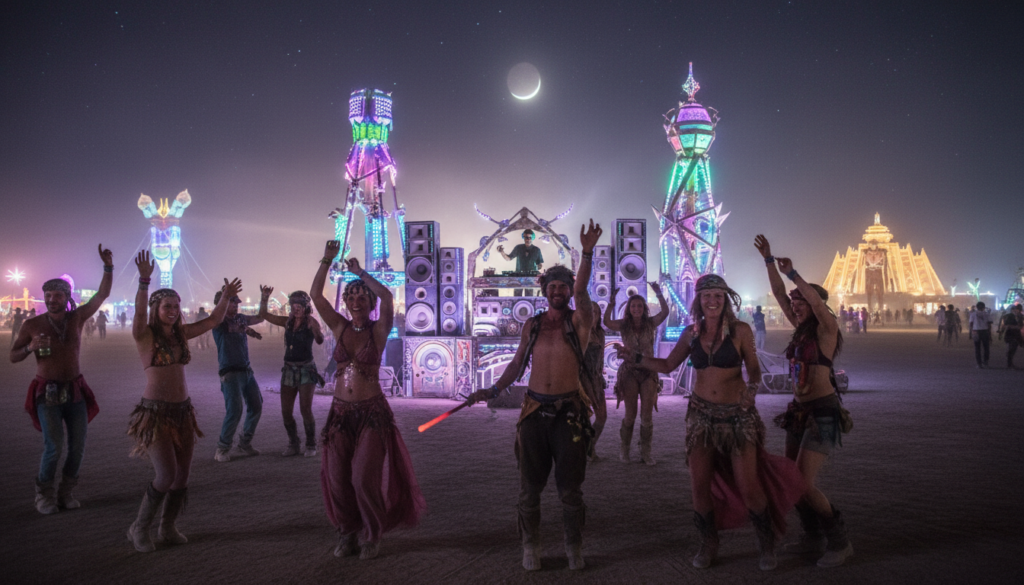
Sound camps and DIY stages
Sound camps are participant-run hubs that host DJs, bands, and experimental audio art. DIY stages can be anything from a converted RV to a glowing pavilion.
They often run late into dawn and invite people to join, DJ, or improvise live sets.
Range of genres and vibes
Expect ambient lounges, disco throwbacks, live-instrument jams, and massive electronic nights. Each camp crafts its own mood and tempo.
“Music here rewards wandering: follow a beat and you’ll find community.”
- Explore by bike or on foot and follow sounds.
- Ask campmates about impromptu sets and sunrise sessions.
- Respect quiet zones and ask before recording people.
| Feature | How it shows up | Why it matters |
|---|---|---|
| No lineup | Discover performances across camps and art cars | Keeps the experience emergent and participatory |
| Sound camps | Host DJs, workshops, and community dances | Let people create scenes rather than buy tickets |
| Volume & consent | Loud zones and quiet spaces coexist | Promotes respect and safer nightlife for everyone |
Mutant Vehicles and Transportation in Black Rock City
Art cars light up the night and move like small, roaming stages through Black Rock City. These licensed, transformed rigs act as mobile artworks and social hubs. They host pop-up performances and help bridge distant camp neighborhoods.
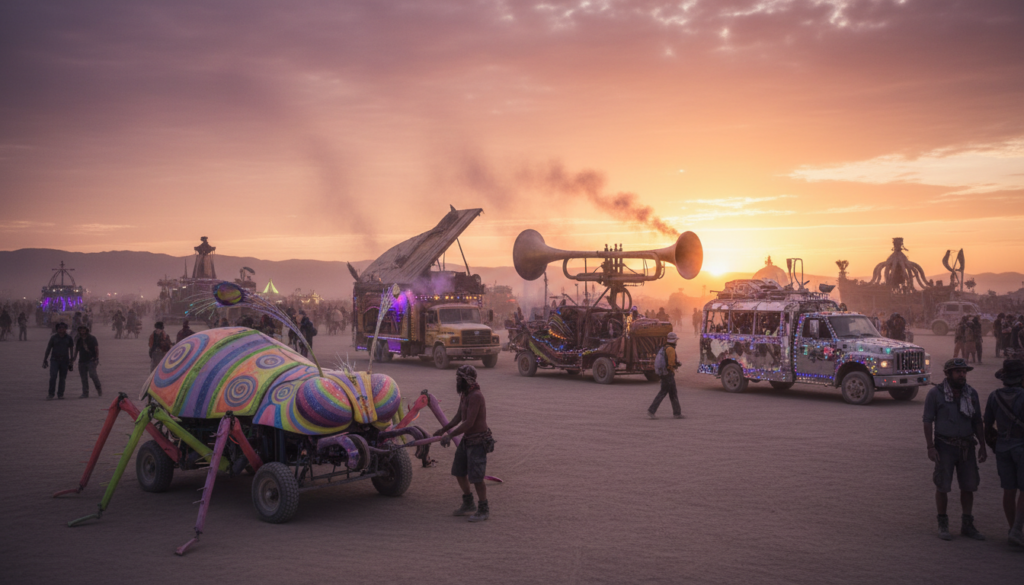
What these rolling artworks do and why they matter
Mutant vehicles are properly permitted vehicles altered into creative forms. Riders gather, dance, and meet new people on board. Culturally, they make nighttime travel feel magical and connect far parts of the grid.
Transportation baseline and rules
Black Rock City favors pedestrians and bicycles; regular driving stays mostly banned. Exceptions exist for staff, emergency rigs, and approved mutant vehicles that follow strict rules.
Why restrictions exist and practical tips
Rules grew from real harm: past vehicle accidents caused severe injuries and deaths, so safety drives policy.
- Bring a reliable bike and lights for night travel.
- Expect limited repair help unless a camp offers aid.
- Don’t chase moving art cars; respect loading limits and signal clearly when boarding.
Tip: plan routes, lock your bike, and treat mobile art with care. For packing comfort and travel gear advice, see this glamping packing guide.
“Mutant vehicles bring wonder, but safety on the playa requires clear rules and shared responsibility.”
Theme Camps and Community: How Thousands of People Co-Create the City
Theme camps act like neighborhood hubs, powered by friends who bring ideas, gear, and care.
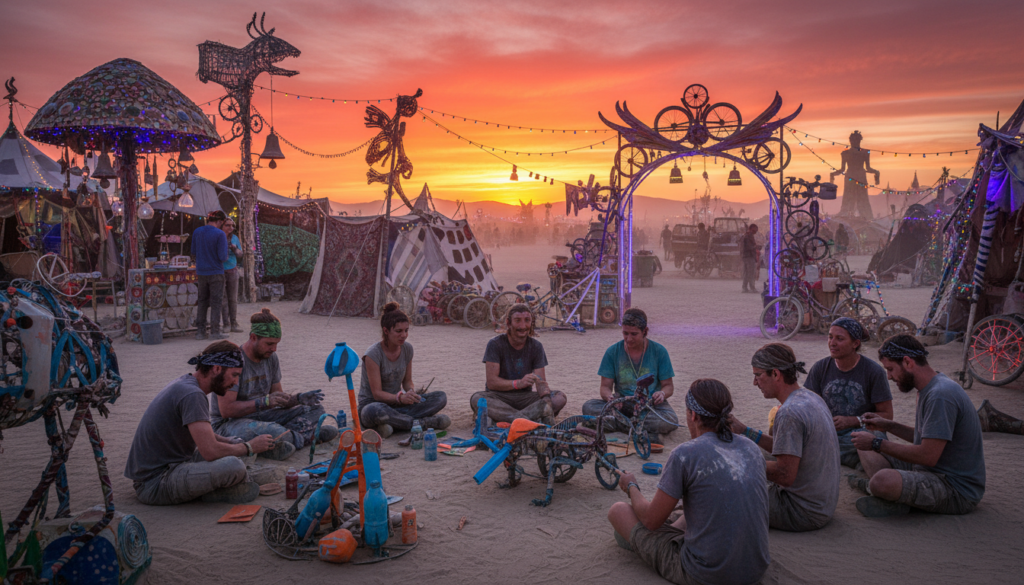
What makes a camp the city’s heartbeat is simple: groups set up shared space and offer goods or services through gifting. These offerings range from food and workshops to music and repair bays.
How camps coordinate and collaborate
Neighboring camp members sync placement, sound hours, and shared programming so the grid stays livable. Coordination prevents clashes and helps creative planning across the plaza.
Volunteering and peer-support roles
Volunteering gives quick access to belonging. From setup shifts to hospitality and on-shift safety roles, many join to help the larger community keep running.
“Ranger-style support culture favors de-escalation, guidance, and practical aid without judgment.”
- Examples: dance floors, tea spaces, sober meetups, skill clinics like welding and costuming.
- Joining a camp, starting a small offering, or signing up to volunteer all matter.
As the event grows, strong camp culture and volunteering keep it human-scale and welcoming.
Survival Basics in the Nevada Desert Environment
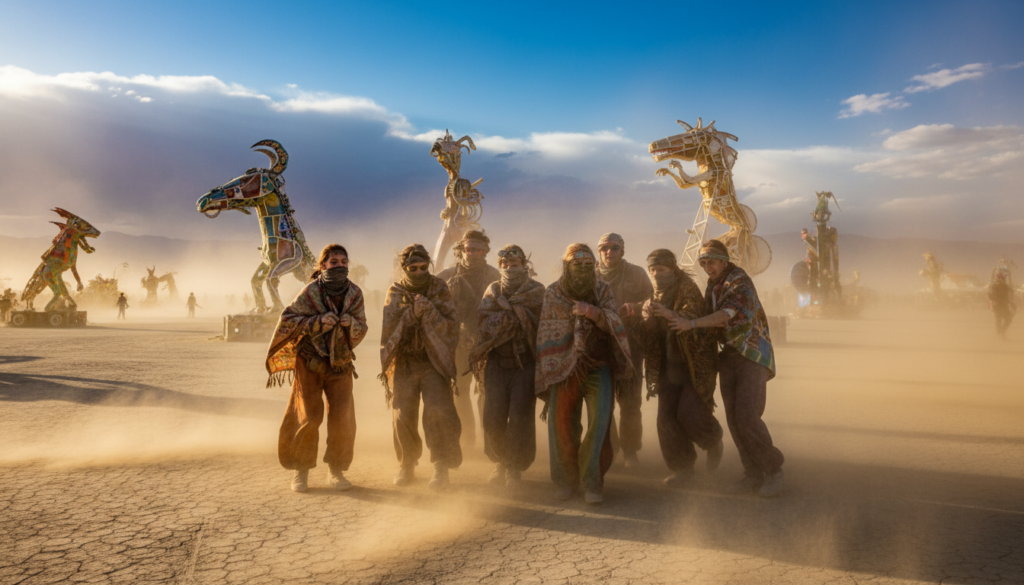
Surviving the playa starts with accepting that the Nevada desert can change fast. Heat, bright sun, wind, and dust can arrive within minutes. Plan daily habits that protect health and preserve energy.
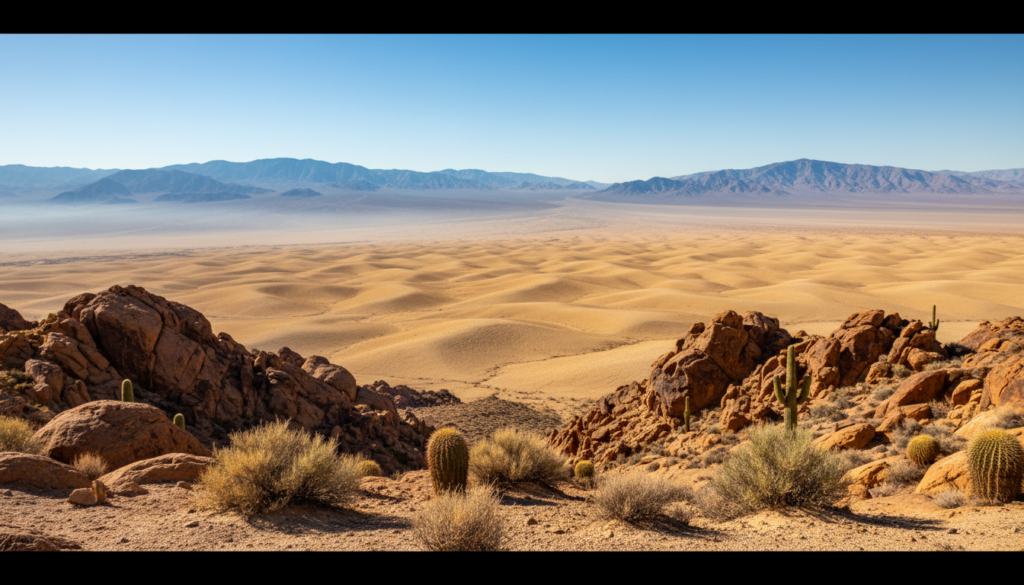
Heat, dust storms, and hydration: habits for day-to-day care
Hydrate early and often. Carry water, use electrolyte mixes, and eat balanced meals so energy holds up during long days of exploring.
Rest matters: take shade breaks even when excited. Overheating and fatigue are common risks for attendees.
“Simple routines—water, shade, and slow pacing—are the best first-aid for harsh sun and wind.”
Shelter, shade, and preparing for extreme conditions
Secure shade structures with strong stakes and extra tie-downs. Ventilation keeps tents livable at high temps and prevents dust buildup.
- Pack goggles, masks or respirators for dust storms.
- Anchor gear; know when to pause travel and shelter in place.
- Protect skin and eyes: sunscreen, lip balm, and eye coverings help prevent lasting irritation.
Practical mindset: assume self-reliance for supplies and plan more than needed. For comfort-packing ideas, see beach glamping.
Weather, Emergencies, and Real-World Risks
When weather shifts fast, thousands of people face hard choices about travel and shelter.
What happened during the 2023 wet playa flooding
In 2023 heavy rain turned the playa into deep mud and interrupted the normal flow of the event. Organizers declared driving bans, delayed key burns, and urged attendees to conserve food, water, and fuel.
Road closures, driving bans, and changing exodus timing
Wet playa means limited vehicle movement, restricted emergency access, and road closures that can shift hour by hour. Exodus timing changed dramatically in 2023; planned departure windows became unpredictable and congestion rose.
Safety, preparedness, and community response
Plan for delays: bring extra food, water, medications, warm layers, and fuel so a holdover remains uncomfortable rather than dangerous.
- Shelter safely and avoid risky walking routes during heavy traffic.
- Follow official guidance and conserve critical supplies.
- Watch for updates from organizers and your camp leads.
“Neighbors helped neighbors, shared updates, and adapted activities so morale stayed strong during the mud.”
Costs, Tickets, and the Question of “Big Business”
Ticket price often masks true outlay. A regular ticket listed near $575 in 2023 covers entry but not travel, shelter, or basic supplies.
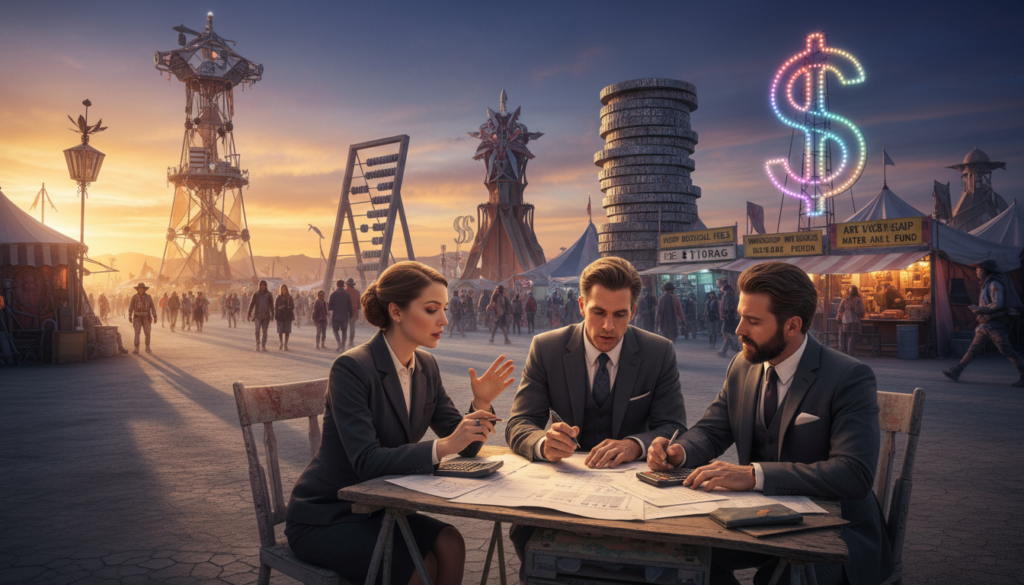
Real-world price breakdown
Travel, camp fees, water, food, costumes, and gear add up. Reports from CNBC suggested total trip costs can reach roughly $1,500 for many people in a single year.
That figure rises quickly if you add paid camping, deliveries, or private transport.
Why “big business” comes up
Decommodification remains a core rule, yet wealth shapes comfort. Luxury camps and influencer visits have drawn critique for changing norms.
Some argue these trends clash with self-reliance and gifting; others say they fund large art projects that benefit the whole site.
- Budget tip: share gear with campmates and borrow bulky items.
- Save smart: prioritize water, shelter, and medical supplies over flashy costumes.
- Future note: the community keeps negotiating boundaries to protect non-commercial values as visibility grows.
Laws, Boundaries, and Respect: What Attendees Should Know
Laws and consent shape how freedom plays out inside Black Rock City. Even with open creativity, federal and Nevada statutes still apply. Enforcement has happened in past events, especially around controlled substances and vehicle safety. Treat that reality as non-negotiable.
Federal and Nevada law still applies
Black Rock City sits on public land and falls under state and federal jurisdiction. That means officers can act on reports of illegal activity. Vehicle rules, permits for moving art cars, and public-safety orders are enforced to keep people safe.
Substances, consent, and personal responsibility
Do not assume permissive norms protect you. Myths about “anything goes” lead to poor choices, citations, or arrest. Controlled substances remain a high-risk area for enforcement and harm.
“Freedom here depends on clear boundaries, respectful action, and looking out for one another.”
- Consent: always ask before photographing, touching, or entering camp spaces.
- Look after friends: know limits, stay together, and don’t leave someone alone when they struggle.
- Respect quiet zones: follow posted hours and camp boundaries to reduce harm.
| Topic | Practical rule | Why it matters |
|---|---|---|
| Law enforcement | Follow state and federal statutes on public land | Prevents legal trouble and protects everyone’s safety |
| Substances | Avoid illegal drugs; seek help for medical issues | Reduces risk of arrest and serious harm |
| Consent & privacy | Ask first for photos, entry, or close contact | Maintains trust and preserves community culture |
| Vehicle rules | Use permitted mutant vehicles and bike safely at night | Prevents accidents and preserves movement on the grid |
Safety is community care, not rule-killing. Following boundaries keeps the experience open for more people. If you want tips for low-impact participation or neighborhood-scale contributions, see this short guide on joining small community efforts.
Conclusion
This guide ends with one clear point: contribution makes the project work. ,
The gathering sits in Black Rock Desert where people co-create Black Rock City through art and community. It began on June 22, 1986 on a San Francisco beach and grew to tens thousands by 2019.
There are no headliners to watch. Show up ready to give time, skills, or small gifts. Follow the Ten Principles, honor the gift economy, and leave no trace.
Plan with trusted sources like burningman.org, pack for desert safety, and budget for self-reliance. For comfort ideas try this glamping guide.
As weather, scale, and visibility change, community choices will shape what the event becomes. Prepare well, join in, and help make something meaningful.