
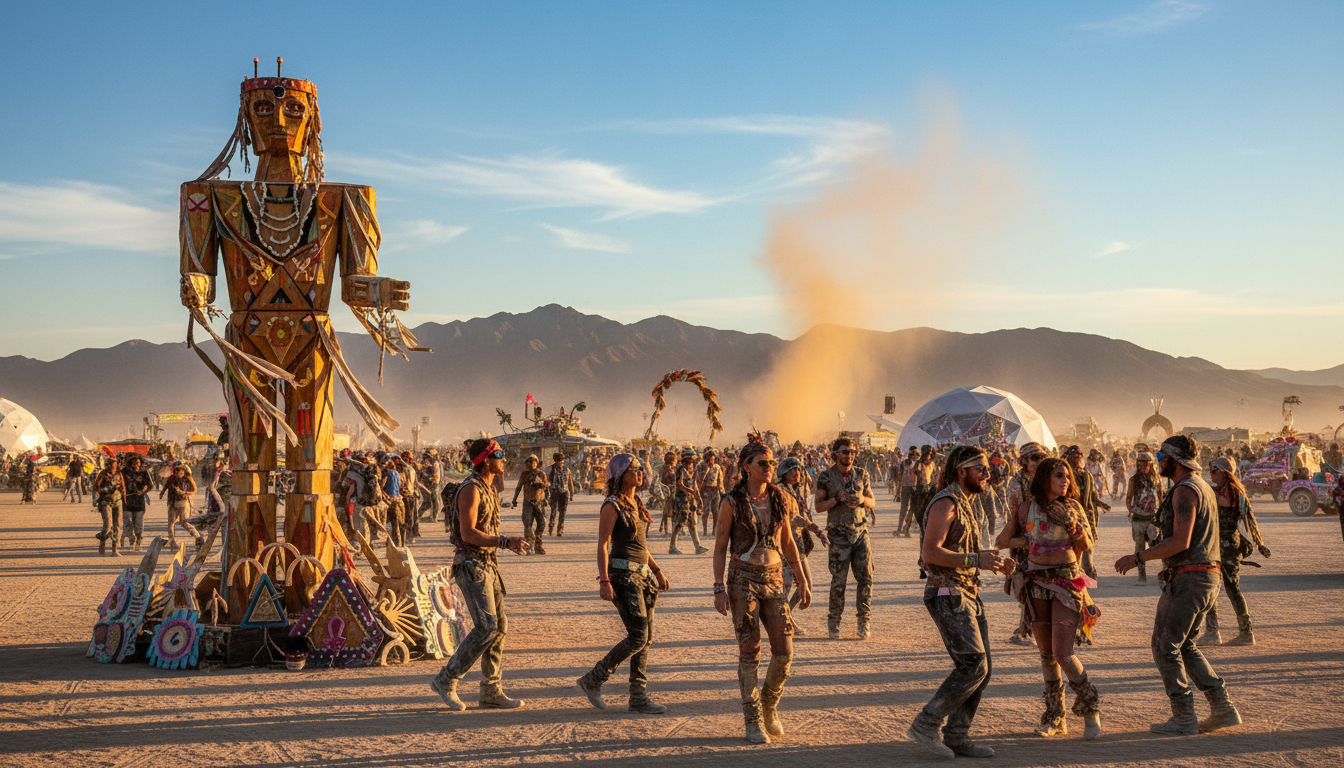
strong, Burning Man is a week-long desert event that centers on community, art, self-expression, and self-reliance. It ends with the symbolic burning of a wooden effigy on the Saturday before Labor Day. This guide gives clear, factual information and friendly context.
You will find practical details about where and when this festival takes place, plus why it matters culturally. Expect a plain-language roadmap that covers Ten Principles, the gift economy, art and theme camps, and how Black Rock City runs as a temporary city.
Participation matters more than spectating. The guide explains how to join, how to stay safe, and how to plan a budget. It also lists dates, coordinates, and organizational facts from the Burning Man Project so you get reliable facts, not rumors.
Key Takeaways
- Clear definition and key dates for the event.
- Overview of Black Rock City and participant roles.
- Summary of Ten Principles and gift economy.
- Art, camps, rules, safety, and budgeting tips.
- Verified facts from official organizers for credibility.
What Is the Burning Man?
A week in Nevada’s playa becomes a cooperative experiment of large-scale art, community, and self-reliant living. Participants build a temporary city, stage interactive projects, and then remove every trace when it ends.
Definition: This event gathers thousands who prefer making experiences over buying entertainment. Volunteers, artists, and neighbors work together to create camps, sculptures, and shared activities.
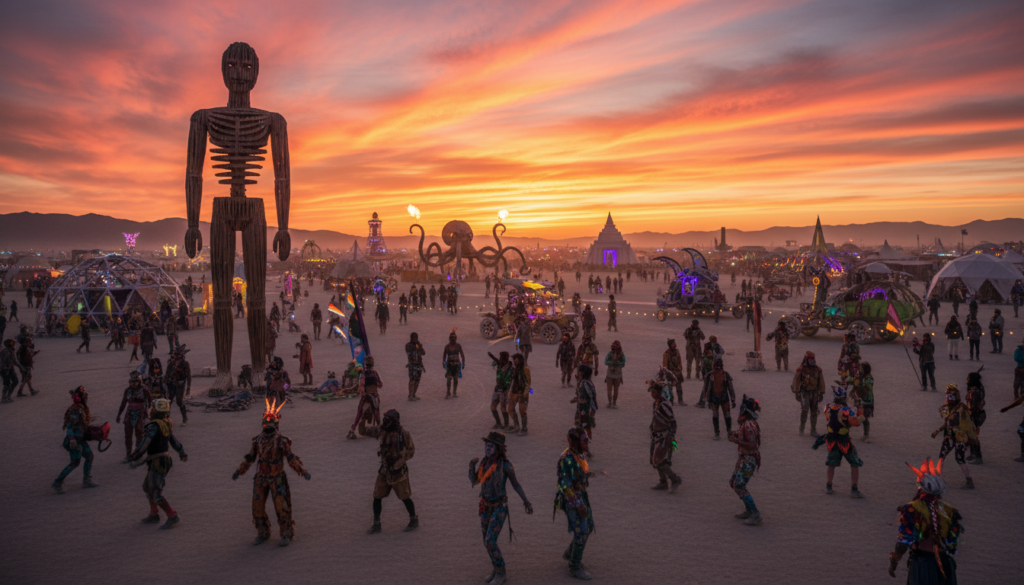
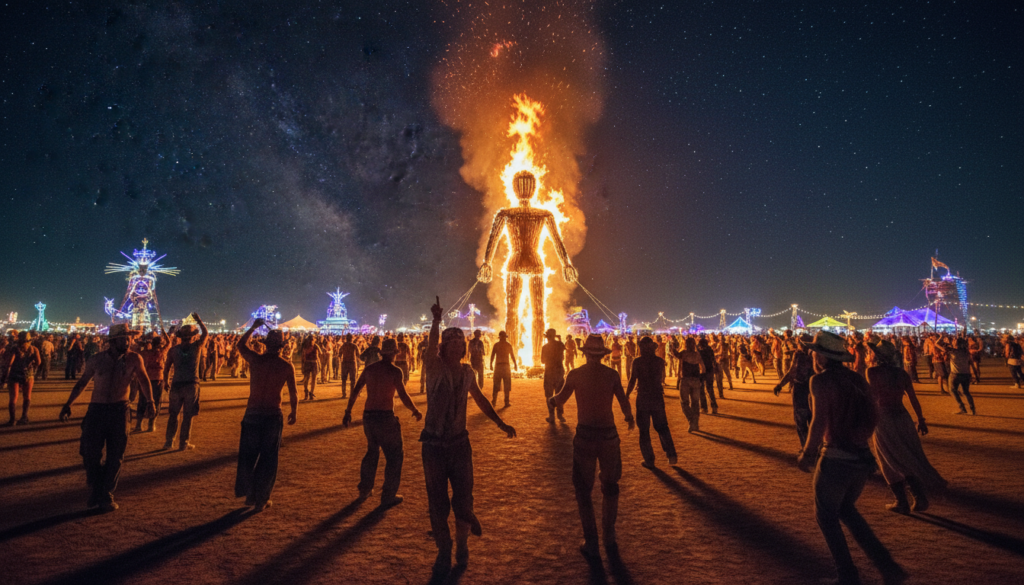
Why the name matters: On Saturday night before Labor Day a huge wooden effigy called the Man is set alight. That ritual serves as a communal release and a focal point for many.
“Participation, not passive attendance, defines the project.”
Language around this culture matters. People say burners, participants, or attendees, but participant carries weight. It highlights responsibility, gifting, and teamwork in city building and cleanup.
Location and timing shape planning, supplies, and weather readiness. For a contrast with other outdoor stays, see glamping guide.
Where Burning Man Happens: Black Rock City in the Black Rock Desert
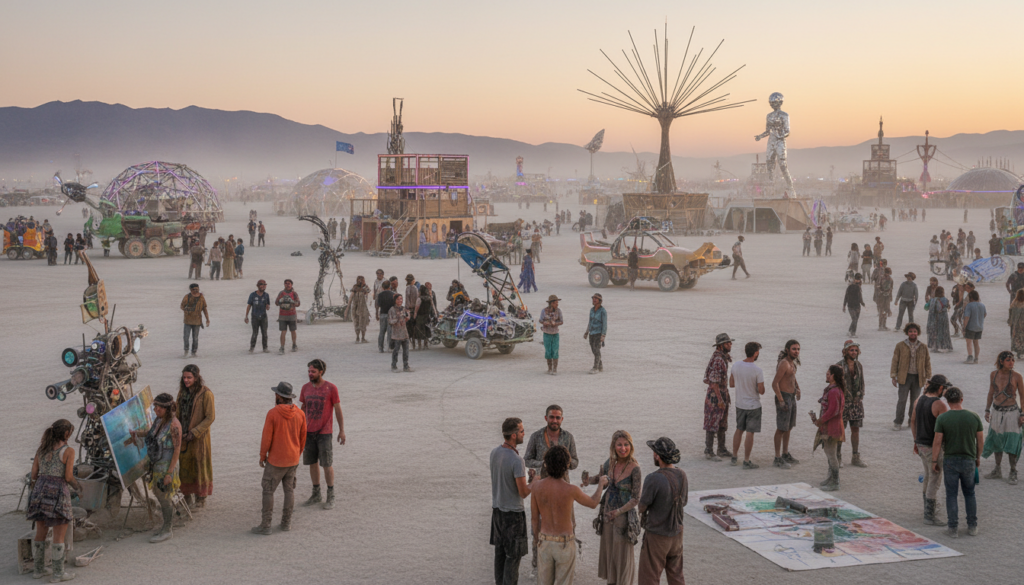
A temporary urban grid rises on a vast, level playa each year and lasts only for the event. That grid becomes a functioning city with streets, addresses, and systems for safety and waste removal.
Black Rock City as a temporary city in Pershing County, Nevada
Black Rock City sits in Pershing County, about 100 miles (160 km) north-northeast of Reno. Since 1990 this place has hosted burning man on the playa, then removed every trace afterward to restore the land.
Getting oriented: the playa and Nevada environment
The black rock desert is a hard, flat lake bed. Expect alkaline dust that coats gear, intense sun by day, and sudden storms that bring wind and mud. Preparation matters for comfort and safety.
Exact location reference
Use these coordinates for planning: 40.7869°N, 119.2042°W. This pinpoint helps navigation and emergency mapping for rock city layout and access.
| Feature | Detail | Practical note |
|---|---|---|
| Location | Black Rock Desert, Pershing County, Nevada | ~100 miles (160 km) from Reno for supplies |
| Coordinates | 40.7869°N, 119.2042°W | Use for GPS and emergency services |
| Environment | Alkaline playa, high sun, possible storms | Bring dust protection, sun shelter, rain plan |
| City model | Temporary grid with roads, named streets, zones | Designed for navigation, services, and safety |
When Burning Man Takes Place Each Year
Timing matters: this event runs each year in late summer, spanning nine days that end on Labor Day. The main ritual — the burn of the Man — happens Saturday evening before Labor Day, and most activity clusters around that night.
The typical week rhythm
Arrival and build take the first days as thousands set up camps and large art pieces. Midweek features daytime installations and growing evening programming.
Peak nights draw the biggest crowds, with many ticketed and volunteer-led shows. Saturday night centers the effigy burn, then Sunday and Monday focus on cleanup and teardown.
Why timing shapes planning
Late-summer heat, sudden dust storms, and occasional rain affect supplies and shelter choices. First-timers must plan extra days for setup, volunteer shifts, and safe departure windows.
- Scale: thousands arrive and leave within tight windows, which affects gate lines and city services.
- Self-reliance: the schedule dictates how many days you must carry water, food, and fuel.
- Logistics: art burns and volunteer rosters follow strict timing, so arrival early in the week matters.
From Baker Beach to the Playa: A Brief History of Burning Man
A simple bonfire on Baker Beach in 1986 grew into a cultural experiment that later reshaped a desert skyline.
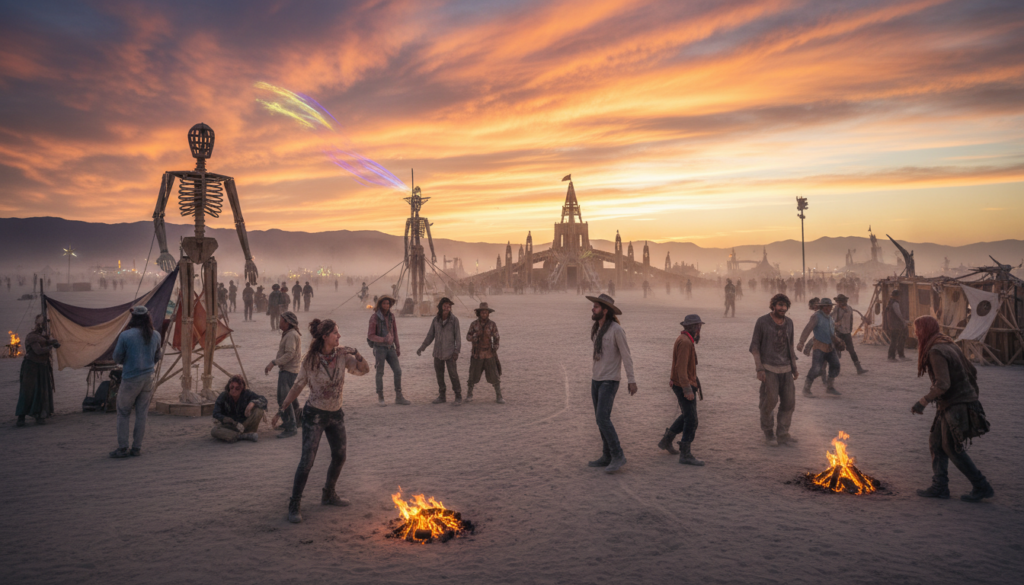
Origins: On June 22, 1986, Larry Harvey and Jerry James set a wooden effigy alight on a San Francisco shore. That early ritual drew a small group and a curious crowd.
Early San Francisco roots (1986)
The gathering on Baker Beach was spontaneous and theatrical. It carried playful rebellion and creative expression.
The 1990 move to the Black Rock Desert
A 1990 trip, often called Zone Trip No. 4, shifted the event inland. The playa’s empty expanse let participants experiment with large-scale art and city-building.
Growth across years
Over subsequent years this event exploded in scale. It evolved from a beach ritual into an annual project that drew tens of thousands of people.
- Key figures: Larry Harvey, Jerry James, John Law, and ties to the Cacophony Society.
- Scale marker: Official attendance reached 78,850 in 2019.
- Transformation: The desert setting made self-reliance and temporary city logistics central to the experience.
“What began as a shore-side act became a vast, participant-built community on open playa.”
For a contrast on coastal gatherings and outdoor stays, see this short guide to beach glamping.
Who Runs Burning Man Today: The Burning Man Project and How It’s Organized
A nonprofit now manages planning, permits, and public outreach for this large desert gathering.
Nonprofit structure and recent history
The Burning Man Project took over formal leadership in 2013. Black Rock City LLC, formed in 1999, became a subsidiary of the nonprofit.
How organization shapes the city and rules
Hosting a major event on federal land needs coordination with agencies like the Bureau of Land Management. Permits set layout limits, burn rules, and environmental requirements.
- Examples: numbered addresses for emergencies and restricted driving inside the playa.
- Regulation: controlled burn platforms and waste-removal plans keep the desert safe.
| Role | Who | Outcome for participants |
|---|---|---|
| Organizer | Burning Man Project | Permits, fundraising, city planning |
| Operator | Black Rock City LLC | On-site logistics and volunteer coordination |
| Land manager | Bureau of Land Management | Environmental rules, access, burn approvals |
Rules balance safety, desert protection, and the long-term ability to hold the event. That way participants can plan with reliable information and data.
The Ten Principles That Shape Burning Man Culture
A clear code of shared values steers choices, art, and daily routine in camp life.
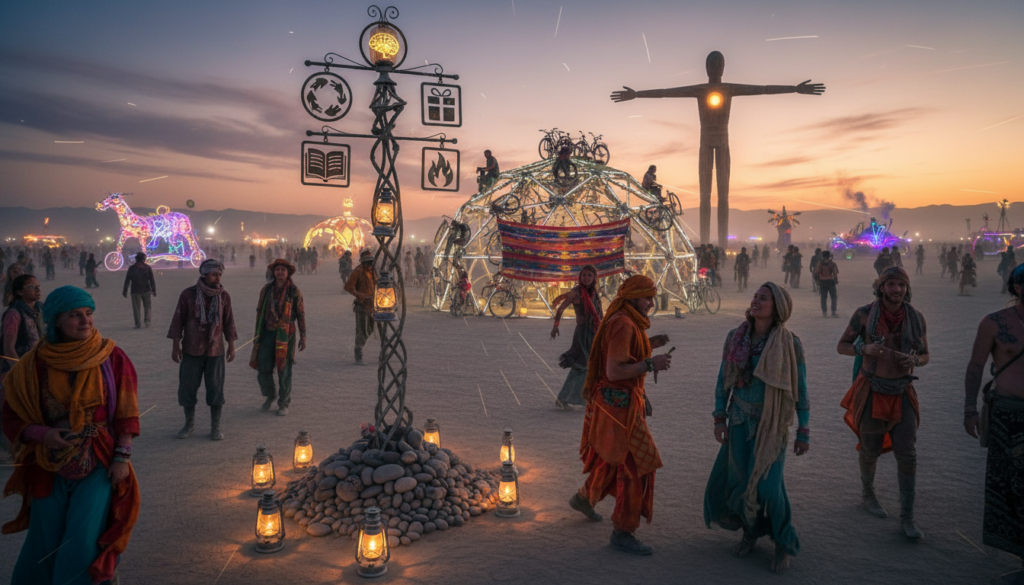
Larry Harvey wrote these ten ideas in 2004 as a guide, not a rulebook. They help participants decide how to act and how to build community in Black Rock City.
Key ideas and everyday examples
Radical inclusion means welcoming people from many backgrounds. Camps invite strangers to join workshops or meals.
Participation shows up when someone hands out water, helps erect an art piece, or hosts a shared meal. Everyone adds value by doing.
Immediacy asks people to be present. That can mean unplugging, joining a conversation, or trying a new creative role that day.
Gifting, civic duty, and desert care
Gifting and communal effort act as social glue. Volunteers, artists, and neighbors trade time, skills, and favors instead of cash for most exchanges.
Leaving no trace and civic responsibility tie directly to survival. People clean camps, respect safety rules, and protect fragile land for future seasons.
Decommodification in plain language
Decommodification prohibits ads, corporate sponsorship, and sales that turn experiences into transactions. It keeps focus on community value rather than branding or profit.
“These principles help a temporary city run on trust, creativity, and shared responsibility.”
- Ten principles: a cultural framework for behavior and art.
- Community: built by practice, gifts, and hands-on participation.
- Stewardship: leaving no mark and acting as responsible neighbors on the playa.
Gifting, Decommodification, and the Playa Economy
A gifting culture shapes daily life on the playa and shifts how people connect.
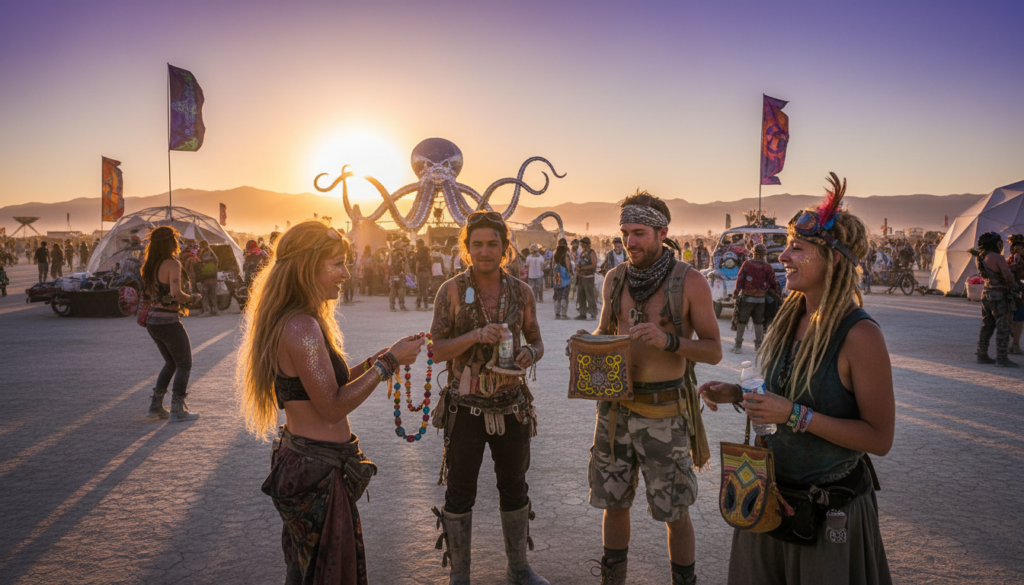
Decommodification discourages ordinary buying and selling so art and participation stay central. That rule creates a different social vibe from most festivals. People trade attention, skills, and time rather than cash.
Limited, practical exceptions
Some sales do happen. Ice and coffee are commonly cited exceptions, and a few licensed vendors may provide essentials. Those exceptions help safety and comfort without turning the city into a marketplace.
Everyday gifts and social ways
Gifts can be simple or elaborate: a late-night grilled cheese, a bike repair, a sunrise performance, a hands-on workshop, or help rigging shade. These offerings build relationships, not ledgers.
“Gifting turns exchange into connection.”
| Aspect | Typical example | Why it matters |
|---|---|---|
| Food | Shared meals, snacks, late-night treats | Creates community and sustains participants |
| Services | Bike repairs, shade setup, teaching | Solves needs and strengthens ties |
| Art & performance | Interactive installations, small shows | Drives participation and meaning |
Reminder: radical self-reliance still applies. Gifts appear often, but plan water, shelter, and supplies first. For packing help and comfort ideas, see this glamping packing guide.
Art at Burning Man: Installations, Interactive Builds, and Big Ideas
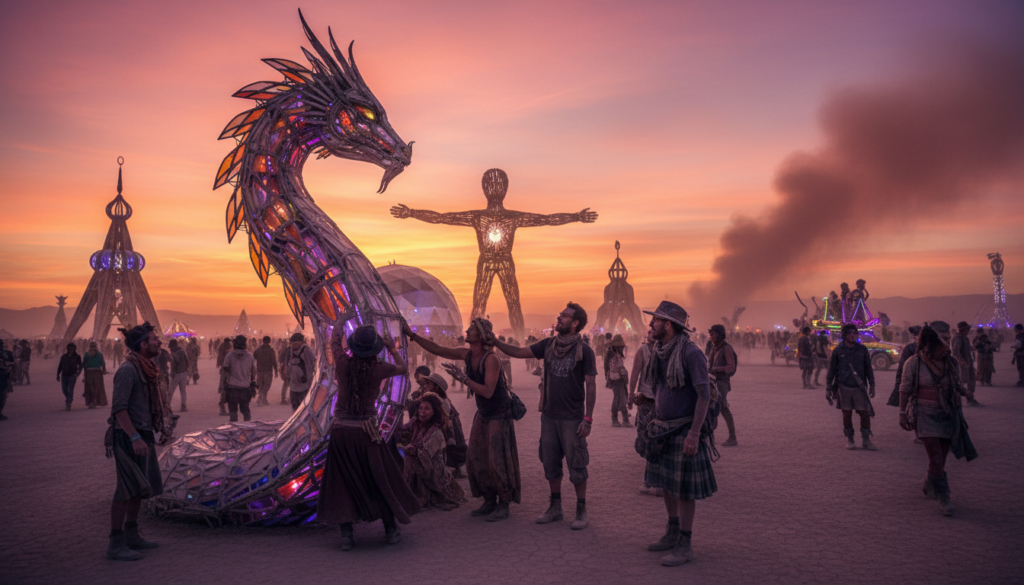
Large-scale sculpture, immersive rooms, and surprise performances turn open sand into a hands-on art lab.
Why there are no headliners
Participants create nearly everything on site. Unlike a typical festival with star acts, this event relies on people to plan, fund, and present projects.
That model makes the city unpredictable and alive. You arrive and find experiences shaped by community effort, not corporate booking.
Sculptures, performances, and experimental media
Expect huge sculptures, walk-in installations, pop-up theater, and experimental sound and light works. Many pieces invite touch, entry, or collaboration.
Music appears through sound camps and spontaneous sets, but it supports art rather than headlining the program.
Theme-driven creativity
Each year’s theme gives creators a starting point. Some projects follow that prompt closely, while others stretch it into surprising forms.
“Art on the playa asks you to join, not just observe.”
| Form | Example | How participants engage |
|---|---|---|
| Large sculpture | Metal or wood effigies | Climb, walk around, photograph responsibly |
| Interactive installation | Light rooms, touch-activated pieces | Enter, trigger responses, co-create |
| Performance | Site-specific theater, dance | Join scenes or become part of a cast |
| Experimental media | Immersive AV, generative art | Listen, wear gear, respond physically |
Mutant Vehicles, Art Cars, and How People Move Through Rock City
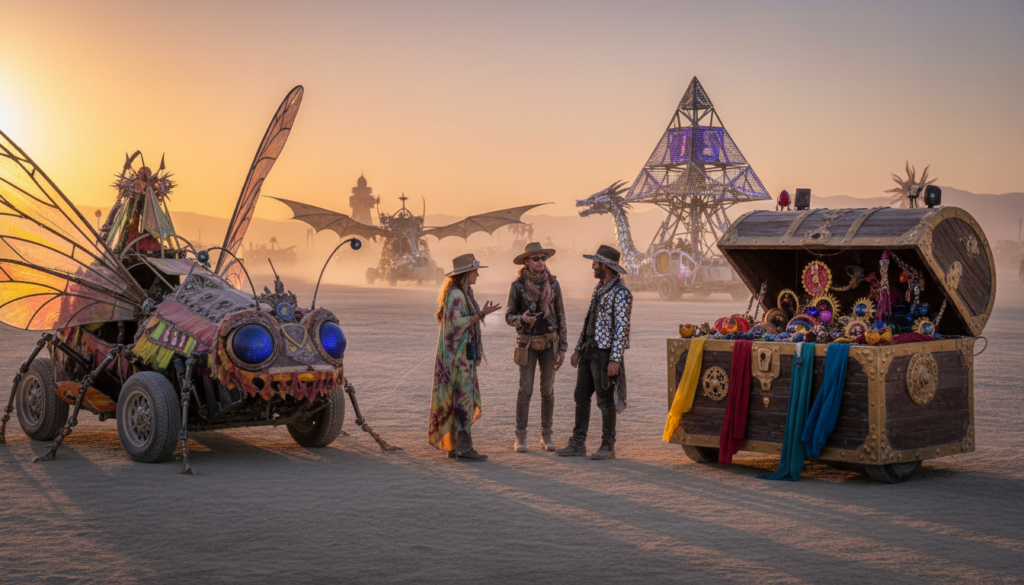
In this temporary city, converted rigs approved to carry passengers become part transport, part installation.
Defining transformed rigs and why they stand out
Mutant vehicles are dramatically altered cars, trucks, or buses that receive approval to operate on playa roads. They serve as rolling art, social lounges, or small stages.
Rules that shape movement
Driving is limited. Only approved art cars and service vehicles may move after dark. Speed stays at 5 mph across the city to protect foot traffic.
Safety standards and their purpose
Standards cover lighting, clear signage, and secure seating. They exist because visibility drops at night, dust reduces sightlines, and pedestrian density is high.
What this means for you: expect to walk or bike for most trips. Art cars add flavor and offer rides, but they are a special layer, not a default transit option.
“Slow speeds and strict approval keep art mobile while protecting everyone on the playa.”
| Aspect | Requirement | Why it matters |
|---|---|---|
| Approval | Event permit for modified rigs | Ensures safety checks and route limits |
| Speed | 5 mph limit | Protects walkers and cyclists |
| Visibility | Lights, reflectors, spotters | Reduces accidents in dust and dark |
| Access | Restricted driving zones | Keeps camps and pedestrian areas calm |
Many art cars connect to camps and programming. That link leads naturally into how camps shape community life in Rock City.
Theme Camps and Community Life in Black Rock City
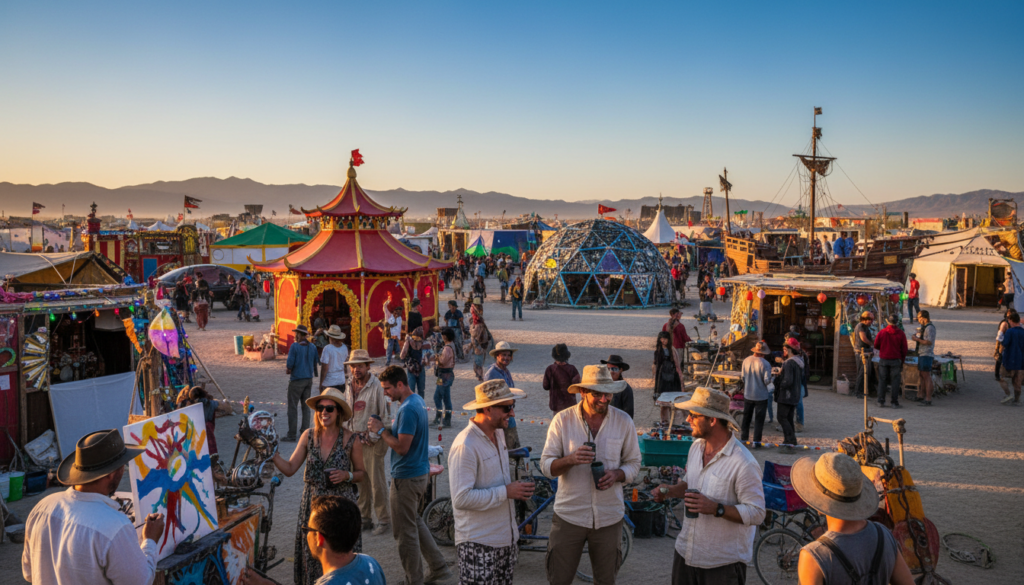
Theme camps turn empty playa space into steady places where people gather, eat, learn, and create. Each camp offers a focus: morning movement, tool help, a chill dome, or a tiny dance floor. Camps shape how community moves through the temporary city.
How camps operate and what they offer
Camps host meals, teach workshops, run repair stations, and stage performances. Many set fixed hours so visitors know when to drop in.
Examples: sunrise yoga, bike repair, communal dinners, lectures, pop-up bars, and quiet lounges.
Participation, labor, and self-expression
Camps give participants a clear role and shared purpose beyond wandering a festival. Volunteers plan logistics, haul gear, and staff shifts before and during the event.
Radical self-expression appears in camp design, costumes, themed rituals, and hands-on workshops. That creativity connects people and fuels community bonds.
“Micro-communities build a larger city by sharing skills, space, and responsibility.”
- Hosts provide services that help everyone stay safe and fed.
- Participants learn by doing and by teaching each other.
- Camps form the backbone of Black Rock City’s daily life.
The Temple and the Emotional Side of the Burning Man Event
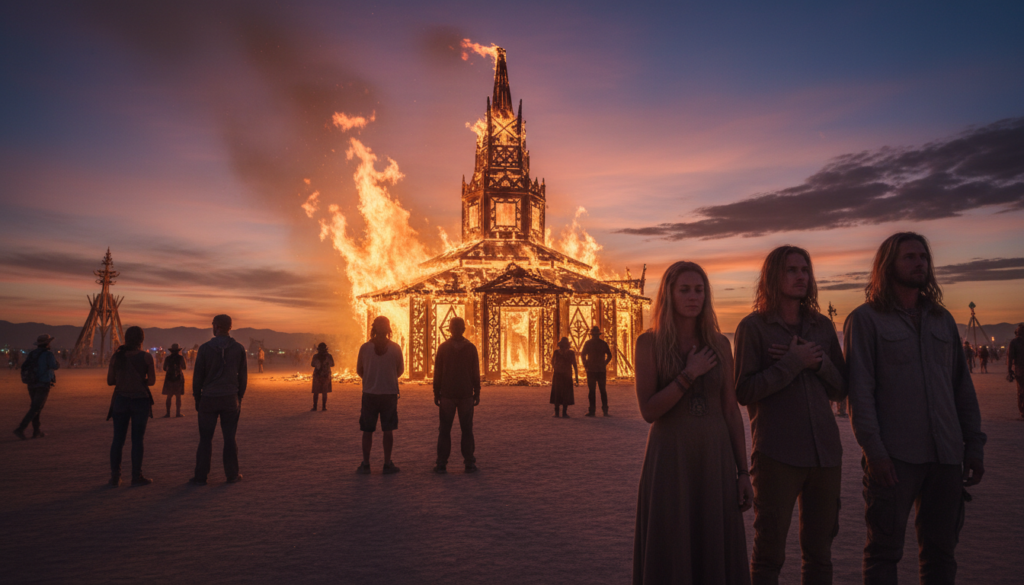
Amidst bright nights and busy streets, one structure on the playa invites quiet and deep reflection.
Meaning and use
The Temple serves as a defining emotional space for remembrance, ritual, and private reflection. Many people leave notes, mementos, or art that honor losses and milestones.
Visitors sit, read, or write in silence. Volunteers staff hours for calm programming and to protect items left by others.
Temple beside the burn
The event stages the effigy burn and the Temple burn as separate moments. One offers communal release and spectacle, while the other supports grief, memory, and slow letting go.
That contrast makes the overall experience richer. Participants move between catharsis and quiet, shaping a more layered visit to the desert.
“The Temple turns a temporary city into a space for real human reckoning.”
| Aspect | Purpose | Etiquette |
|---|---|---|
| Remembrance | Leave notes, small offerings | Respect silence, no photos in some areas |
| Reflection | Private time to grieve or center | Keep voices low, tidy offerings |
| Ritual | Scheduled ceremonies and final burn | Observe timing and safety rules |
How Burning Man Works Day to Day: Participation Over Spectating
Life on the playa runs on a mix of schedules, serendipity, and small favors that keep the city going.
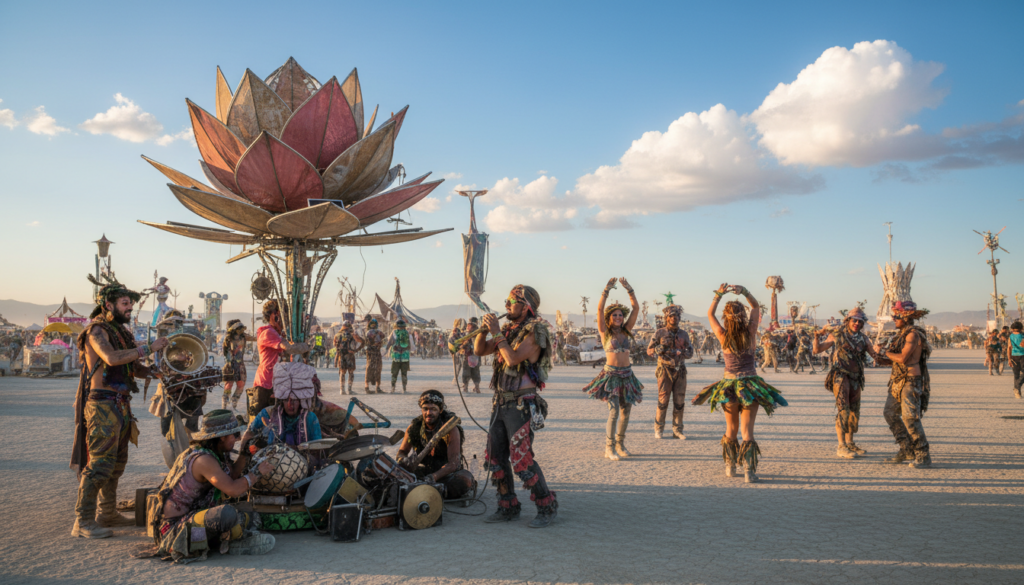
Morning: many participants rise early to tend camp—haul water, fix shade, and check art pieces. Heat and dust shape choices, so routines include sun shifts and dust checks.
Afternoon: people run workshops, prep meals, or finish installations. Some follow posted schedules; others rely on word-of-mouth or a quick radio broadcast to learn what’s happening next.
Building plans while staying open to surprise
Teams mark volunteer shifts and art build times so heavy tasks get done. At the same time, chance encounters spark shows or pop-up performances. Both planning and spontaneity are essential.
Immediacy and the “you are the content” mindset
Immediacy means showing up and taking part. Say yes to invitations, try a short shift, or hand out water. Your small action becomes part of someone else’s experience.
Volunteering, civic roles, and shared responsibility
Volunteers staff safety teams, greeters, and art crews. Civic roles keep the city functioning: medical, traffic, trash crews, and camp leads all matter. When you pitch in, the whole event runs smoother.
- Find key information on bulletin boards, camp listings, and local radio.
- Check morning briefings and ask neighbors for quick updates.
- Bring a flexible attitude; your contribution, however small, helps the community.
“Participation turns attendance into a living, shared city.”
Rules, Safety, and “Leave No Trace” in the Black Rock Desert
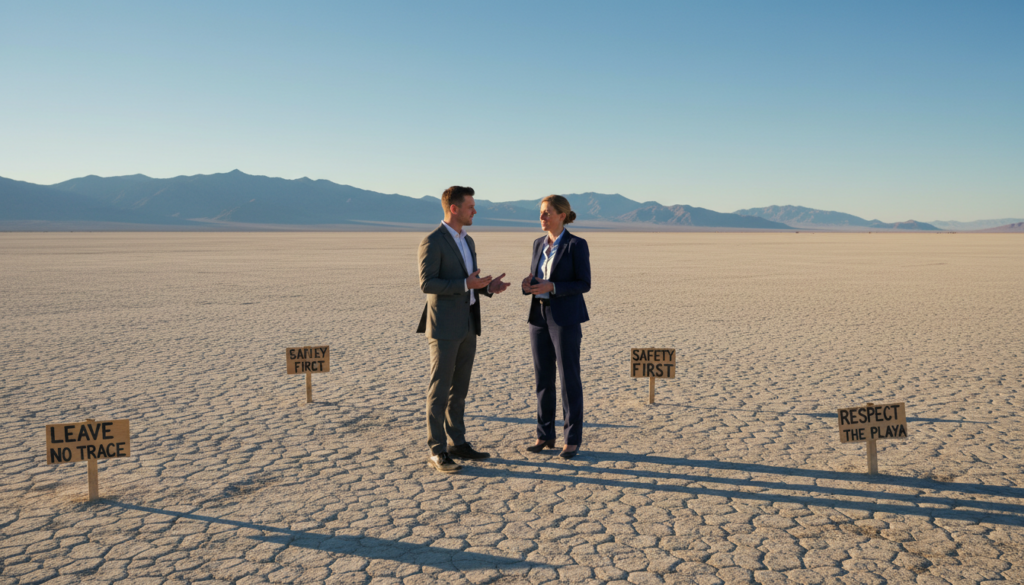
Safety and stewardship make this temporary city possible. Rules here are practical requirements tied to permits from land managers, not optional suggestions. Following them keeps the event allowed on public land and protects fragile playa soils.
The trash fence and perimeter purpose
A 9.2-mile plastic trash fence marks the boundary around camp. It catches windblown debris and clearly defines where the event ends.
Why it matters: the fence reduces litter spread, helps crews collect stray items, and shows regulators that participants control impact.
Fire safety basics and approved burns
Art that will be set alight must sit on approved burn platforms and meet safety plans. Open or careless fires are a major hazard on alkaline playa and in high winds.
Fireworks, open flames off approved platforms, and animals are banned to reduce risk and protect land health.
Rangers and community support
Black Rock Rangers and volunteer teams de-escalate conflicts, guide lost people, and advise on safety choices. They are a peer-based safety net, not enforcement only.
“Rules exist so a creative city can run safely in a harsh desert.”
| Safety element | What it requires | Practical result |
|---|---|---|
| Leave No Trace | Pack out all waste, avoid marking ground | Permit compliance and preserved playa |
| Trash fence | Perimeter barrier to catch debris | Reduced wind loss and easier cleanup |
| Fire control | Approved platforms, burn plans, no fireworks | Safer art burns and fewer accidents |
| Community Rangers | Peer support, guidance, conflict mediation | Faster help and calmer outcomes |
Practical mindset: follow rules to protect safety and keep future events possible. They preserve the creative experience so participants can focus on art and community without harming this desert home.
Tickets, Costs, and What to Budget for the Experience
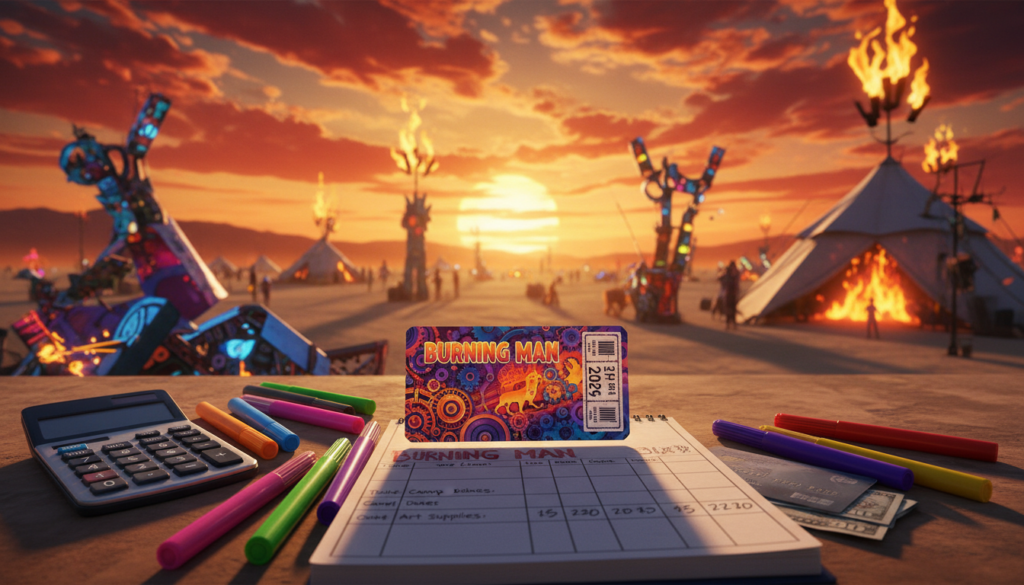
A ticket starts access, but real expenses show up in gear, food, and logistics. Historically demand has been high — official attendance reached 78,850 attendees in 2019, and many years sold out quickly. Recent reports note unsold tickets in 2024, which is useful context for planning but not a guarantee of lower costs.
What a ticket usually covers: entry to the playa, city services, and access to programmed events. It rarely pays for camp gear, transport, food, ice, or emergency supplies.
Budget checklist and realities
- Water and food for a full week plus setup and teardown days.
- Shelter, shade structure, and secure camp gear.
- Goggles, masks, lighting, bike and repair kits.
- Transport, fuel, parking, and ice runs.
- Emergency extras: first aid, spare parts, contingency cash.
Why costs escalate: radical self-reliance means buying or renting durable gear, often at premium prices if left until departure. First-time people underestimate quantities and replacement parts.
“Plan for a week on playa, including build and breakdown days; realistic packing saves money and stress.”
For planning tips that help balance comfort and cost, see this short guide to nature-meets-luxury travel.
Burning Man in the Media and Public Perception
Press attention turned a fringe gathering into a frequent headline. Coverage, influencer posts, and celebrity visits shape many initial impressions.
From counterculture roots to mainstream attention
Local DIY origins drew curious reporters. Over time, glossy pieces and tech-world stories pushed this festival into wider view.
NPR noted the shift toward influencers and Silicon Valley profiles, which changed how many people spot the playa in news feeds.
Common misconceptions
Sensational clips highlight nudity, wild costumes, or parties. That coverage can make some assume an “anything goes” vibe.
Reality: most visitors focus on art, community, and service. Headlines show moments, not the whole day-to-day.
Legal and factual reality
This event runs on public land under federal and Nevada laws. Local rules, permits, and safety plans still apply.
“Media can flatten a complex culture into simple, viral clips.”
- Separate curiosity from quick assumptions.
- Seek credible sources and firsthand accounts before you judge.
- Remember that reporting often favors drama over nuance.
Burning Man Today: Recent Challenges and What They Reveal
Recent years have tested this desert project with weather, public health, and budget shocks. Those disruptions show how a large, participant-run city depends on logistics, permits, and readiness.
Weather extremes and the 2023 lockdown
Weather on the rock desert can flip from dry dust to heavy rain. Strong winds carry alkaline dust; rain turns playa into thick mud and stops movement.
In 2023 rains forced a lockdown that prevented driving. Organizers advised conserving food, water, and fuel and shared survival guidance for those stranded.
Cancellations, unofficial gatherings, and public-health impact
The 2020 and 2021 events were canceled for public-health reasons. Still, unofficial gatherings occurred, with reports estimating about 20,000 people on playa in 2021.
Those unsanctioned meetups strained local services and highlighted how permits and formal infrastructure support safe gatherings.
Financial strain and shifting attendance trends
Recent reports show ticket demand and finance data shifting, including unsold tickets in some years. This pressure affects planning, artist funding, and on-site services.
Organizers, vendors, and camps now balance tighter budgets with permit obligations and safety requirements.
“Disruptions reveal that self-reliance must pair with strong logistics and clear permits.”
Practical takeaways:
- Build flexibility into travel and arrival plans.
- Pack for extremes: shelter, spare water, fuel, and contingency food.
- Treat radical self-reliance as non-negotiable when facing uncertain conditions.
| Challenge | Example | Lesson for participants |
|---|---|---|
| Weather | 2023 flooding lockdown | Plan for no-driving scenarios and conserve supplies |
| Public health | 2020–2021 cancellations and unofficial gatherings (~20,000) | Permits and formal support matter for safe, large-scale events |
| Financial | Recent unsold tickets and budget pressure | Expect shifting services and fund-raising needs |
Conclusion
strong, Think of this as a compact map: a participant-built city of art, shared responsibility, and hard-earned logistics.
Burning Man forms a temporary Black Rock City each year where art and camps shape daily life. Ten principles guide behavior, gifting replaces commerce, and Leave No Trace protects fragile land.
This week feels magical because people build it. At the same time, it needs real planning: supplies, roles, and attention to safety and permits.
If you plan to attend, start with those principles, arrange gear early, and join a camp or volunteer crew. For related comfort tips, check a short glamping guide.
Engage thoughtfully, respect the desert, and pitch in. That is how Rock City becomes a living, shared place rather than a mere spectacle.