
Burning Man is a week-long desert event built around community, art, self-expression, and self-reliance. People gather in a temporary city to create, share, and learn. This guide will go beyond the mainstream idea that it’s only a big party.
Expect a clear, reality-based look at meaning, culture, principles, and how Black Rock City runs. We will unpack key symbols: the Man burn, the Temple, gifting, and Leave No Trace. That context explains unusual rules and a non-commercial vibe.
This festival is not a typical music event with headliners. It’s a participant-built experience focused on contribution and shared moments. Readers in the United States who know only headlines will find a friendly, practical explanation here.
Key Takeaways
- Burning Man centers on community-led art and self-reliance.
- It’s a participant-built city, not a standard concert festival.
- Core symbols—Man burn and Temple—carry deep cultural meaning.
- Non-commercial rules and Leave No Trace shape behavior.
- This guide serves as a practical title and description for curious readers.
- For related outdoor experience context, see a short guide to glamping.
Understanding Burning Man’s Significance in American Culture
A temporary city in Nevada has become a laboratory for shared creativity. For many attendees, this week highlights how people can build culture through hands-on work, public art, and mutual aid.
A week-long desert event centered on community, art, self-expression, and self-reliance
Community and self-reliance coexist here. You bring supplies and skills, yet you also accept and give help in a harsh setting. That mix creates a practical social experiment.
Why the festival’s meaning matters more than the party narrative
Media often trims this down to a party story. That frame misses why many attend: to contribute, to craft public art, and to test new ways of living together.
Attendance spans artists, builders, volunteers, first-timers, and veterans. This variety keeps the event vital and explains its long-running success year after year.
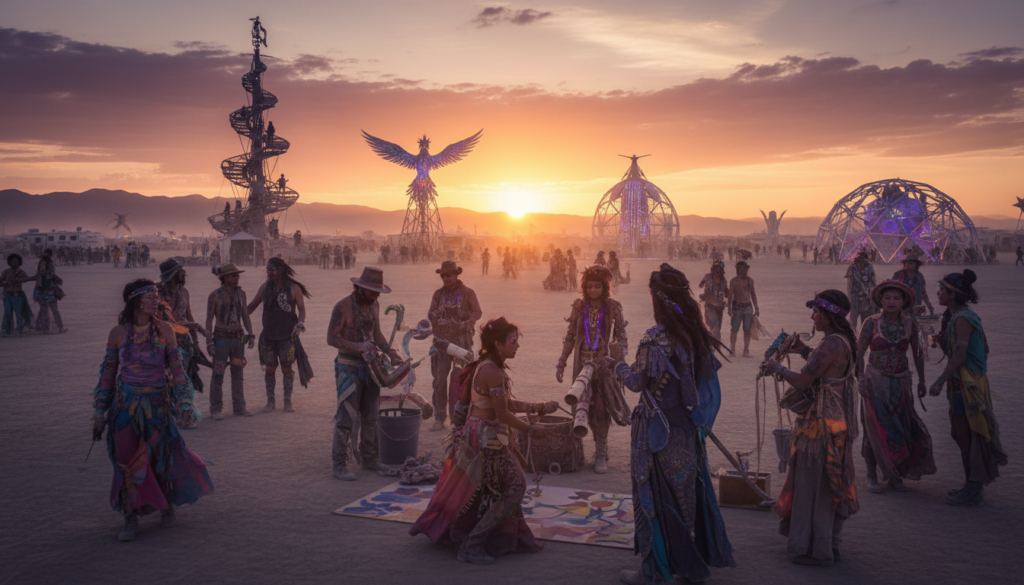
- Participant-driven creation outshines passive consumption.
- Gifting and cooperation reshape social ties.
- The event connects to broader U.S. debates about belonging and meaning in a fast world.
| Aspect | Media Narrative | Cultural Reality |
|---|---|---|
| Focus | Party and spectacle | Community, art, and mutual aid |
| Mode | Consumption | Participation and contribution |
| People | One stereotype | Wide mix of backgrounds and skills |
| Outcome | Short-term fun | Lasting lessons and new social experiments |
Next: we’ll move from this cultural view to personal aims people pursue during their experience.
What is the purpose of burning man for participants today?
Participants arrive ready to build a short-lived city that values doing over watching. For many, what is the purpose of burning man means taking an active role: making art, running camps, teaching skills, and helping neighbors.
Creating a temporary society that prioritizes participation over spectatorship
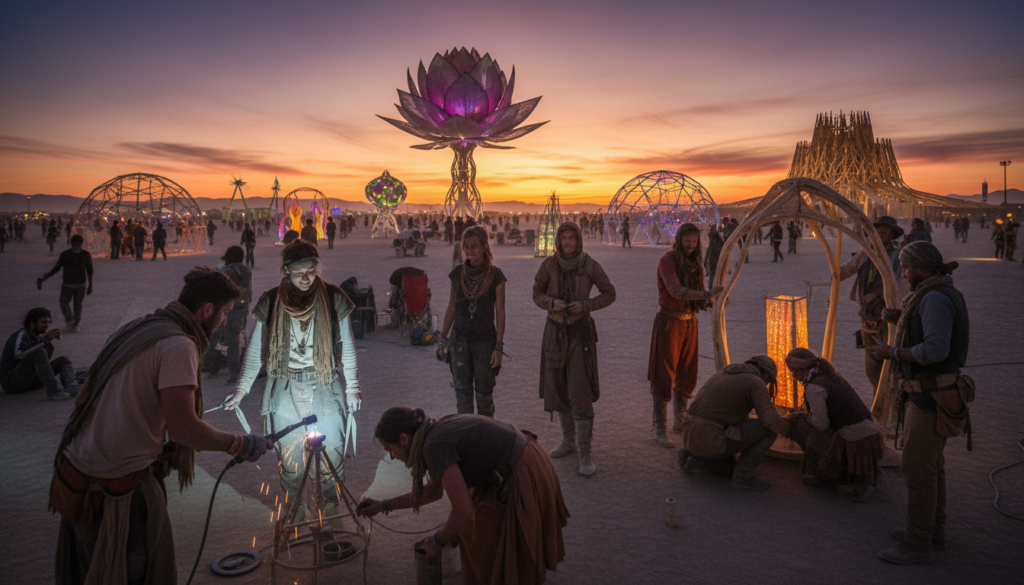
People sign up to contribute. That contribution can be simple service, practical work, or full creative projects. Participation replaces ticketed consumption. This builds a real, living community for a short time.
Testing new ways of living, connecting, and expressing identity
Attendees try roles they rarely have at home. They experiment with costumes, leadership, or community care. These identity tests happen with low stigma and quick feedback. Connections feel direct and immediate in that setting.
Taking lessons “back home” after the burn
Many bring skills and habits into daily life. Volunteers start mutual-aid projects. Artists and organizers launch community work. That ripple shows how a focused week can alter a wider world and the spirit in which people act.
| Participant Action | On Playa Result | After Burn |
|---|---|---|
| Build art | Shared interactive pieces | Public installations, galleries |
| Serve food or aid | Immediate needs met | Volunteer groups, neighborhood aid |
| Lead a camp | Mini-society practices | Organizing skills, civic projects |
Where Burning Man Happens: The Nevada Desert and Black Rock City
In a remote part of Pershing County, a dry lakebed becomes a bustling, short-lived community. Black Rock Desert sits at coordinates 40°47′13″N 119°12′15″W (40.7869, -119.2042), a precise data point for readers who prefer concrete detail.
The playa is a flat, hard-packed dry lakebed. People call it a place because it has its own rhythm, etiquette, and dust-driven rules. That environment shapes art, travel, and daily life.
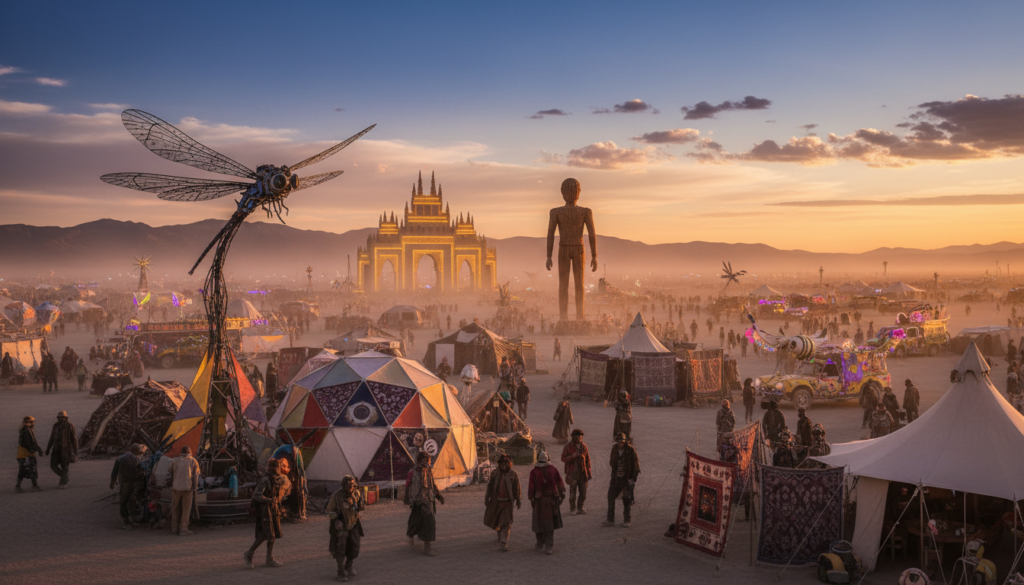
Black Rock City as a built-by-participants pop-up
Black Rock City is erected by attendees. Infrastructure, camps, and services are co-created. Nothing arrives as a packaged product.
Scale matters. Tens of thousands gather; 2019’s official attendance was 78,850. With that many people, systems for safety and water matter as much as creativity.
- Desert conditions force planning and radical self-reliance.
- Leave No Trace responds to a fragile place and long-term stewardship.
- Black Rock, the playa, and the temporary city together form a lived experiment in community.
| Feature | Detail | Why it matters |
|---|---|---|
| Location | Black Rock Desert, Pershing County, Nevada | Defines climate, access, and legal jurisdiction |
| Coordinates | 40.7869, -119.2042 | Precise geographic data for visitors and researchers |
| Attendance | 78,850 (2019 official) | Explains scale and need for rules, safety, and infrastructure |
From Baker Beach to Black Rock: A Brief History of the Event
A small crowd on Baker Beach gathered on June 22, 1986, to burn an eight-foot wooden effigy built by Larry Harvey and Jerry James. That single act began a year-long ripple that turned a local ritual into a recurring cultural event.
The 1986 origin on San Francisco’s Baker Beach
June 22, 1986 marked the first public burn. What began with a handful of friends felt spontaneous and intimate.
The move to Nevada and rapid growth
By 1990 the event moved to Black Rock, where open space let scale happen. The playa allowed growth from hundreds to tens of thousands of attendees over later years.
Organization, permits, and the nonprofit
Expansion required formal permits, safety planning, and coordinated communal effort. In 2013 the Burning Man Project nonprofit succeeded Black Rock City LLC to steward the event and support long-term goals.
History matters because it shows how core practices evolved through collective work, not marketing.
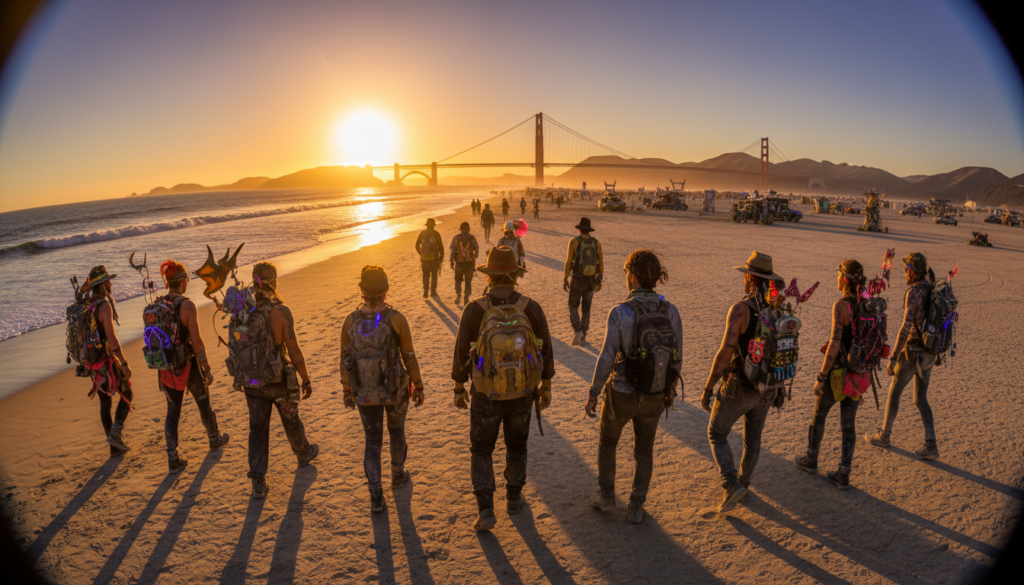
“A ritual that began on a foggy shore became a durable social experiment.”
- Inauguration: June 22, 1986
- Move to Black Rock: 1990
- Nonprofit formation: 2013
The Burning of the Man: Ritual, Symbol, and Shared Time
Late Saturday night, thousands gather as a single structure becomes a focus for shared reflection. That climax gives shape to the week and marks a clear milestone near the end of the event.
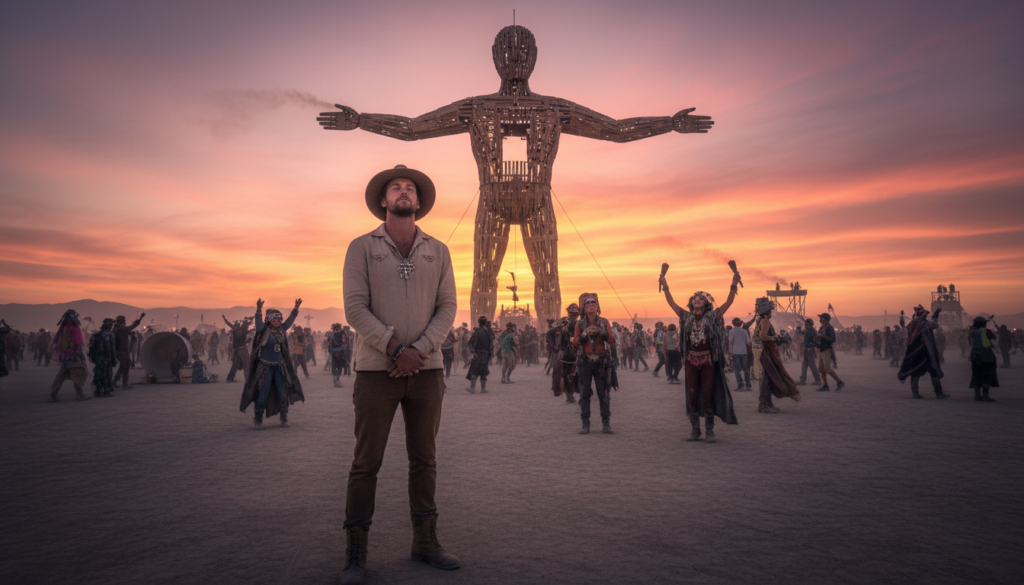
Timing and meaning
The Man is scheduled for the penultimate evening—Saturday before Labor Day—so it follows days of building, art, and mutual help. This timing makes the burning a communal closing act rather than a random spectacle.
Symbol and shared moment
The wooden effigy serves different roles. Some see release and catharsis. Others read it as change, ritual, or simply a tradition shared by many participants.
Shared time matters here. In a city of many separate experiences, the burn creates a rare single point where people gather and watch together.
Safety is layered into the ritual. Cordons, staff, and protocols keep the crowd back so the event stays orderly. The burn does not replace a week of participation; it caps and celebrates it.
“The burn turns many private moments into one public instant.”
| Aspect | Role | Why it matters |
|---|---|---|
| Timing | Penultimate night | Collects a week of buildup into a single milestone |
| Symbol | Wooden effigy | Open to personal interpretation |
| Social effect | Shared point in time | Creates collective memory among participants |
Next, the Temple offers a quieter, more private emotional center that contrasts with this public capstone.
The Temple and the Emotional Heart of the Festival
Nestled apart from spectacle, the Temple offers a slow, reflective counterpoint to the week’s noise.
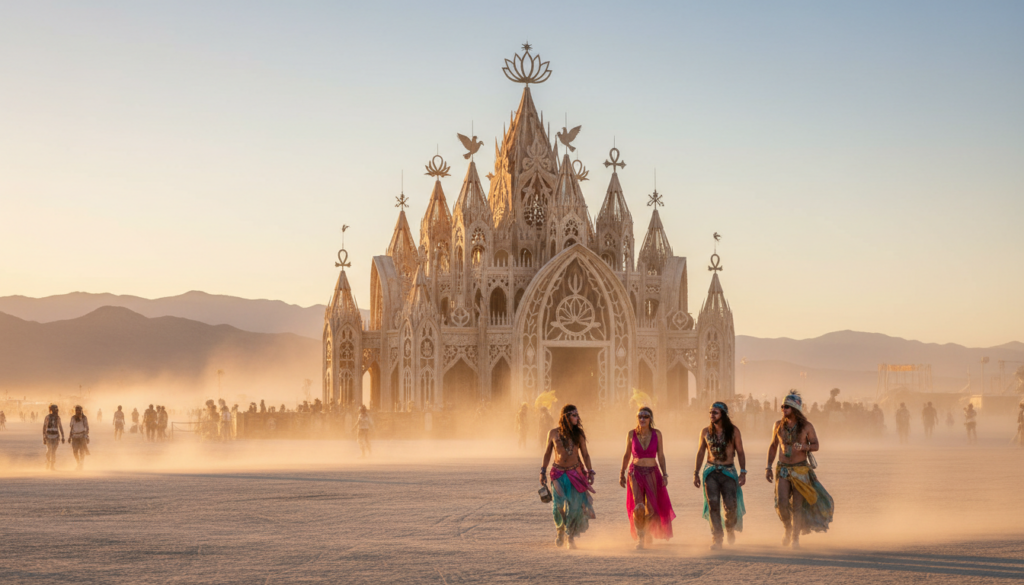
A space for remembrance, grief, gratitude, and introspection
The Temple stands as a quiet place where visitors leave photos, names, and short text tributes. People pin notes, sit in silence, and trace memories with gentle rituals.
Why this experience feels different
This structure functions as art, but its design asks for presence rather than adrenaline. It grows quieter over days and rewards slow attention.
- Personal acts: leave messages, grieve, or give thanks.
- Collective care: many small offerings form a shared archive of feeling.
- Supported work: the Black Rock City Temple Grant helps fund these meaning‑focused builds.
First‑timers should move slowly, expect varied emotions, and respect silence as a form of participation. Both the Man and the Temple speak to the event’s spirit; the next section will outline the Ten Principles that hold these spaces together. For a related, practical read on communal comfort, see a short guide to American comfort foods.
The Ten Principles That Shape Burning Man’s Purpose
A set of ten compact guidelines helps this event hold together amid a busy, temporary city. These principles act as cultural cues rather than strict rules.
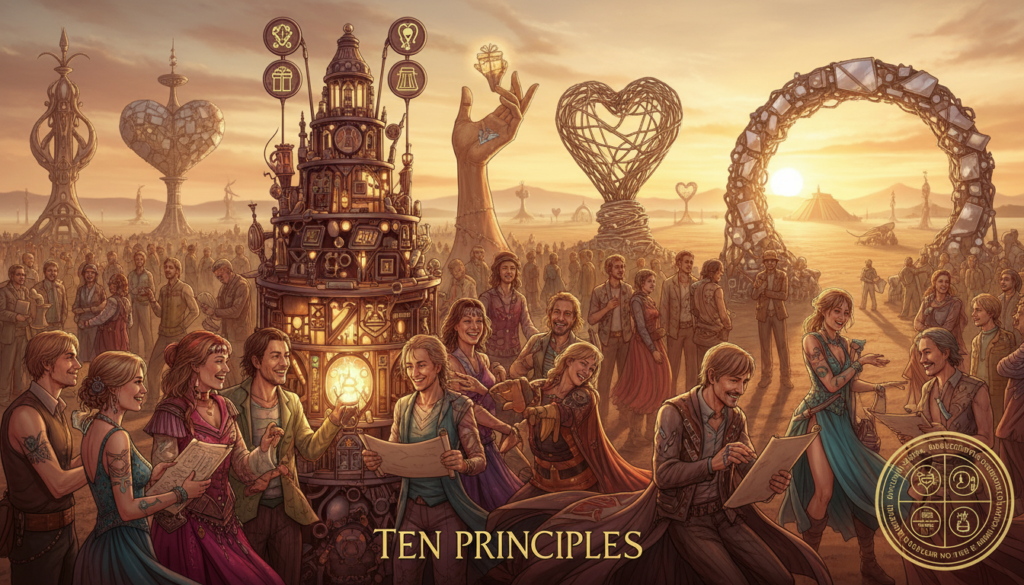
Radical inclusion, participation, immediacy
Radical inclusion invites anyone to take part. Participation and immediacy form the engine: people are asked to do, make, and connect right away—face to face, not online.
Gifting and communal effort
Gifting means offerings without expecting payment. Combined with communal effort, this creates social glue in Black Rock City and makes quick collaboration easier.
Decommodification explained
Decommodification bans advertising and corporate sponsorships. That rule changes interactions: exchanges feel personal, not transactional, and culture grows from contribution instead of commerce.
Self-reliance, civic responsibility, and desert realities
Radical self-reliance means planning for heat, dust, and distance. Civic responsibility asks everyone to watch out for neighbors and follow safety protocols in a harsh desert.
Leaving No Trace and practical cleanup
Leaving No Trace is a concrete ethic: pack it in, pack it out, and hunt for MOOP during post-event cleanup. A ~4-foot trash fence surrounds the playa to catch wind-blown debris and show how seriously containment and cleanup are taken.
“Ten principles guide behavior, not obedience—helping a temporary city run with care and creativity.”
These ideas shape how people behave and lead naturally into the gifting economy, the next surprising part new arrivals meet.
Gifting Economy in Practice: How People Exchange Value Without Commerce
At Black Rock City, a quiet rule guides exchanges: most items arrive as gifts, not goods.
That means you bring what you need and you also give what you can. No price tags. No barter expected. Gifting asks for generosity without keeping score.
One common exception: essentials like coffee and ice have historically been sold, while nearly everything else circulates as gifts. New attendees often hear this early and plan accordingly.
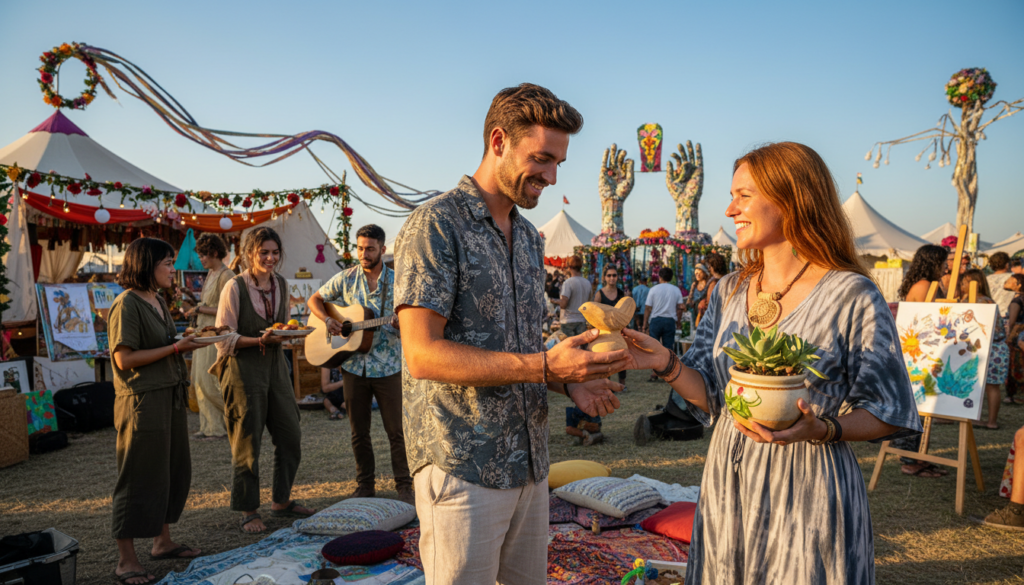
What counts as a gift?
Gifts come in many forms: a grilled cheese, bike repair, a guided sunrise walk, a small artwork, a quick workshop, or water handed off during a dust storm. Services and little acts of care are as valued as created pieces.
How gifting changes relations
When people stop tracking payment, interactions turn present and generous. The city shifts from transactions to moments of connection.
- Practical: micro‑help reduces friction—someone fixes a bike so a camp can run smoothly.
- Social: no receipts mean more trust and fewer comparisons.
- Accessible: gifts don’t need to cost much—thoughtfulness and timing matter more than price.
In this way, gifting supports city functioning and builds a resilient community. Art then becomes the visible engine that invites people to give, join, and take part across the playa.
Art as the Engine: Interactive Installations, Performances, and Participation
Art fuels daily life here; installations, pop-up performances, and hands-on pieces shape how people move and meet. This is an active, lived gallery where creation happens in public and on a large scale.
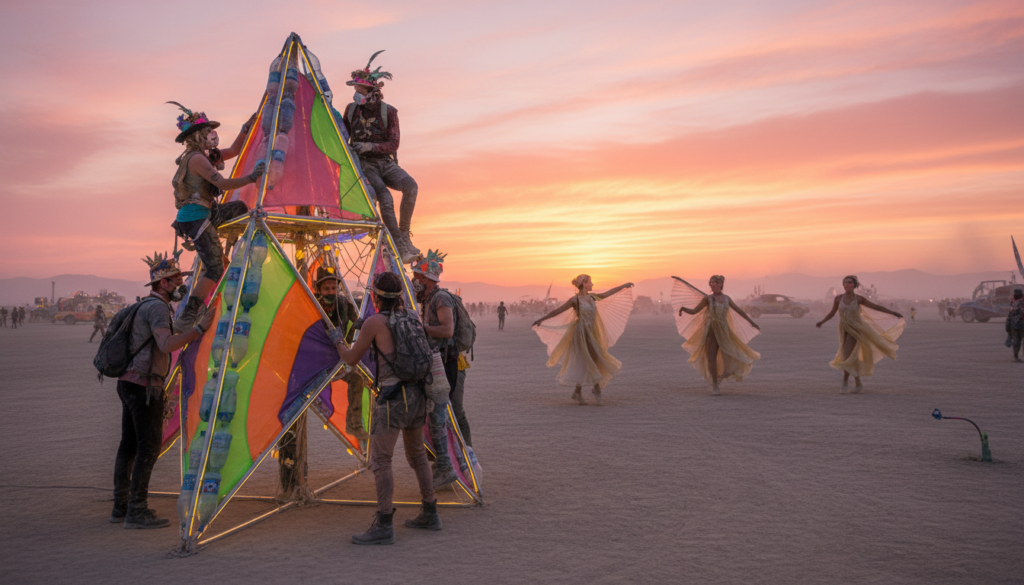
No headliners: participants create it all
There are no headline acts. Instead, participants build stages, run shows, and schedule workshops. That flips a normal festival model: attendees are the makers, not just the audience.
Interactive work meant to be touched and shared
Installations invite entry, climbing, or collaboration. This is not a museum vibe. Pieces ask for touch and teamwork, so moments become shared memories rather than passive viewing.
Support for big projects
Burning Man Arts funds larger builds through Black Rock City Honoraria and Global Art Grants. These programs help teams bring ambitious, interactive work that would otherwise be too costly or complex.
How it hits differently: the blurred line between creator and guest makes impact more direct. Performances emerge organically—pop-up shows, workshops, and participatory happenings anyone can join.
That hands-on culture leads naturally into theme camps, the neighborhoods that host art, services, and daily community life. For inspiration on small-scale making, try a collection of DIY art projects.
Theme Camps, Community Work, and the City You Help Build
Neighborhood-style camps turn a vast desert into small, familiar pockets of care and activity. These clusters give Black Rock City shape and help visitors find routine amid scale.
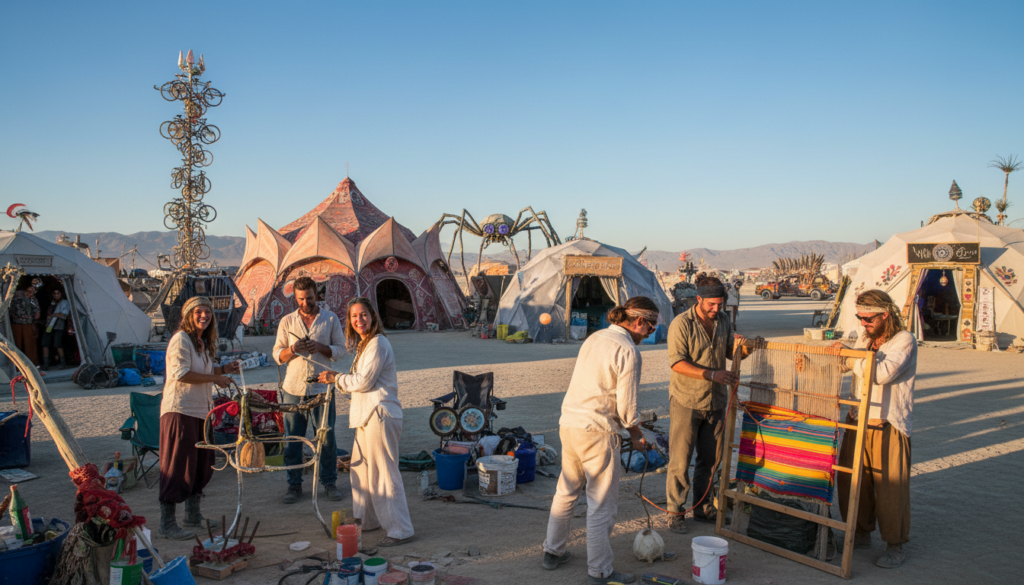
Theme camps as neighborhoods of contribution
Theme camps act like neighborhood blocks. They host workshops, meals, art, performances, or basic services that welcome others. A camp’s role is outward: offer something useful, not hold a private party.
Communal infrastructure and volunteering
Behind the visible life, people build shade, run common areas, staff offerings, and manage cleanup. These tasks keep the city safe and meet Leave No Trace goals.
- Find community by asking, “How can I help?”
- Volunteer roles speed new arrivals into local networks.
- Shared effort turns small contributions into reliable services.
For many participants, this work becomes the core memory: you belong because you gave effort. Next, movement and nightlife—mutant vehicles and music—carry that shared energy across streets without a central lineup.
Mutant Vehicles and Music: Movement, Sound, and Nightlife in Rock City
Art cars roll like bright islands, carrying sound and surprise across Rock City streets.
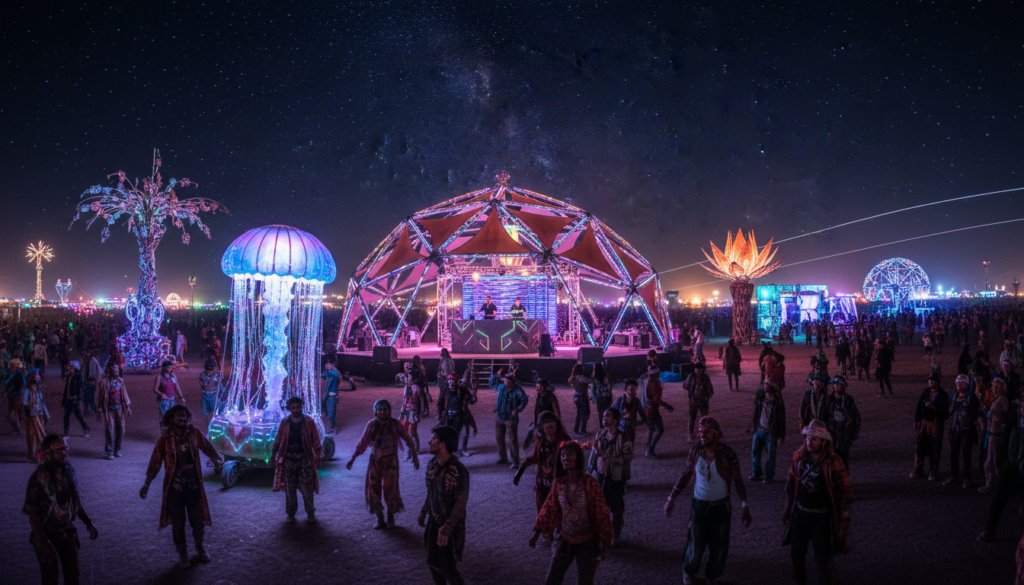
Mutant vehicles are custom mobile stages and participatory sculptures. They run only with approvals and follow strict safety checks. As rolling art, they act as transport, performance spaces, and invitations to join.
How movement shapes discovery
Rather than a schedule, people follow light, beats, and callers to find late-night gatherings. That way of moving turns every street into a chance to discover a new DJ, a small set, or a pop‑up show.
Music without a headline list
There is no official lineup at this event. Camps and art cars host DJs and live sets. To find music, you explore, ask, and follow sound.
- Collaborative builds: vehicles often take months and many hands to complete, mixing art and engineering.
- Practical safety: approvals keep streets walkable and bike-friendly.
- Nightlife balance: late music coexists with quiet zones, service work, and daytime art.
| Feature | Role | Note |
|---|---|---|
| Vehicles | Mobile stages | Require permits and safety checks |
| Music | Distributed sets | Find by exploring Rock City |
| Black Rock City | Shared space | Walkable, bike-friendly when rules are followed |
Tip: newcomers who want calm or a different pace can plan around nightlife. For gear and comfort ideas that fit late nights and long days, see helpful glamping packing tips.
Myths vs. Reality: Debauchery, Sobriety, and What You’ll Actually See
Rumors about nonstop excess often drown out everyday scenes at this desert festival. Sensational stories travel fast in a city of thousands, so media snapshots can seem bigger than life.
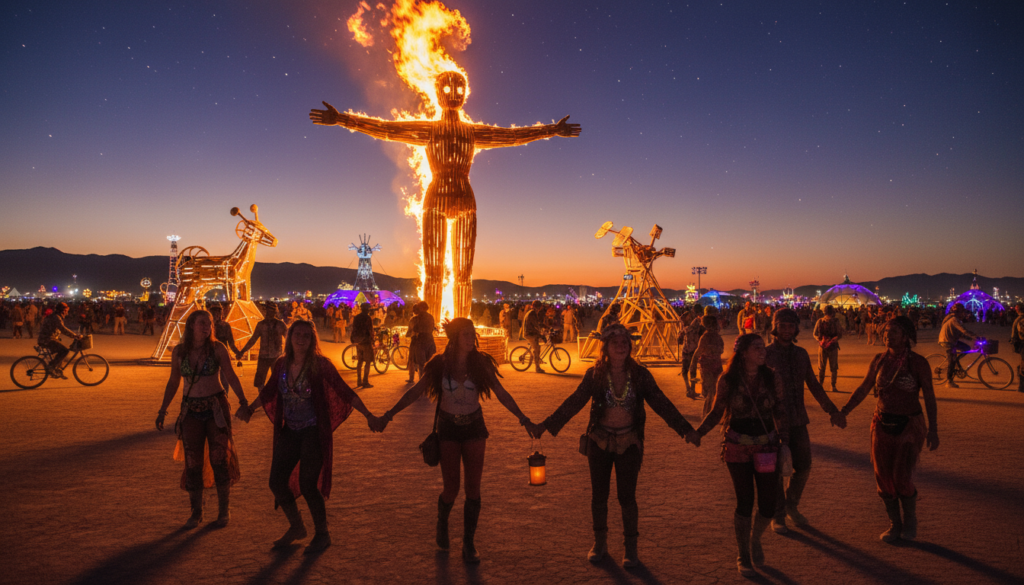
Why sensational reputations persist
Extreme moments — headline-making parties, celebrity visits, and viral images — get the most attention. That skews public description and suggests an “anything goes” way of life.
Sober on Playa and finding community
Sober options are real and visible. Sober camps, meetups, and support groups offer spaces for people who avoid drugs and alcohol.
Many attendees choose those options and still join art builds, teach workshops, or volunteer.
Media distortion and setting expectations
Press often highlights extremes rather than daily culture. That can mislead first-timers about what most people prioritize: service, art, and connection.
Practical tip: plan for variety — quiet mornings, intense art nights, and clear personal boundaries. Understanding the Ten Principles makes behavior norms easier to read than a simple party description.
“Freedom at this festival exists alongside clear rules and shared responsibility.”
Rules, Safety, and Law in the Black Rock Desert
Black Rock brings bold creativity, but safety and law hold it together. Federal and Nevada law apply inside Black Rock City, and enforcement can occur just like anywhere else in the nevada desert.
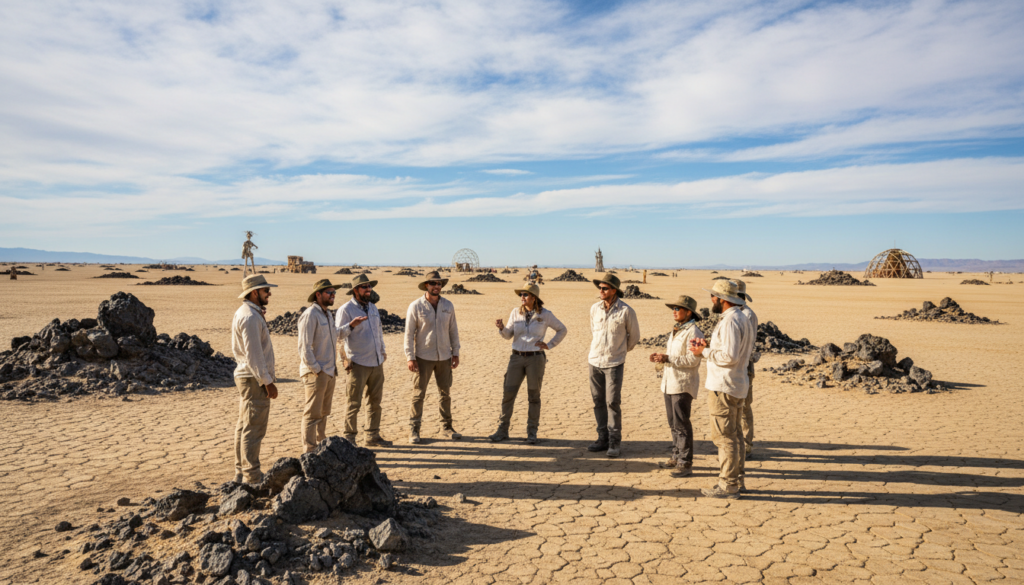
Legal context you should know
Despite a playful atmosphere, standard statutes remain active. Trespass, fire safety, and controlled-substance rules follow state and federal codes. Organizers work with agencies to meet permits and public-safety standards.
Safety structures that keep the event running
Practical systems exist because a temporary city in a remote desert must prevent accidents and medical emergencies.
- Rangers: community-first volunteers who de-escalate, guide, and help lost or injured participants.
- Speed limits: low limits (often about 5 mph) protect walkers and cyclists.
- Burn protocols: approved platforms, safety perimeters, and bans on fireworks around major burns.
“Safety rules protect participation and community, not creativity.”
| Safety Element | Role | Why it matters |
|---|---|---|
| Rangers | De-escalation and support | Keep conflicts small and people safe |
| Speed limits | Street safety | Reduce collisions in dense camps |
| Burn protocols | Controlled art fires | Prevent spread and injury |
Weather can change fast on the playa—dust storms, sudden rain, whiteouts—so situational awareness and radical self-reliance matter. These systems help the culture endure beyond one week and into regional events and public projects. For practical prep ideas, see a short guide to fireproof home ideas.
Burning Man Beyond the Playa: Regional Events and Real-World Impact
A movement that began on a beach now shows up in city parks, galleries, and neighborhood projects around the globe.
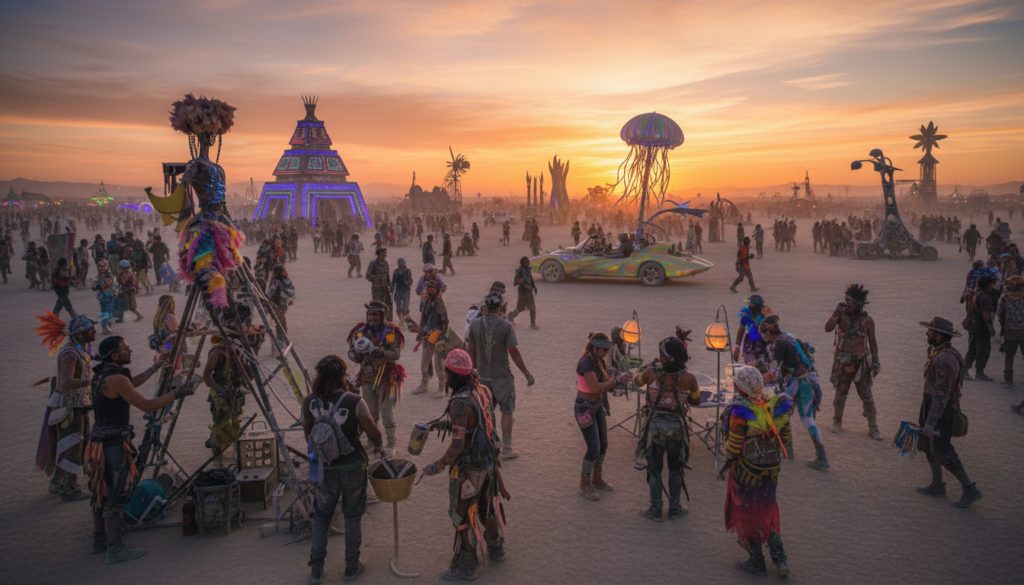
The Regional Network and global reach
Regional events carry core ideas into local scenes. Since the ten principles were penned in 2004, organizers have used them as a guide to launch gatherings across the world.
Taking it home: service, aid, and local work
Many participants turn inspiration into action. That can mean mutual aid groups, community service drives, disaster relief volunteering, or public art projects in hometowns.
- Practical: volunteer-led teams help neighbors after storms or fires.
- Social: gifting and sharing build steadier local networks.
- Creative: small installations and pop-up shows keep art visible year-round.
Public art legacy in Nevada and Reno examples
Some pieces outlive the event. In Reno, large works like Space Whale and BELIEVE (First St & South Virginia St) show how art from playa culture anchors cities.
“Over years, these effects accumulate—turning a week into an ongoing movement.”
Regional gatherings offer a lower-barrier way to join. You don’t need a ticket to Black Rock to practice gifting, volunteer, or help build public art. That local access also sets the stage for debates and change in coming years.
The Future of Burning Man: What Comes Next for the Event and Its Culture
As the event cycle turns toward another year, practical questions meet cultural ones. Planning now includes logistics, troupe schedules, and efforts to protect shared values.
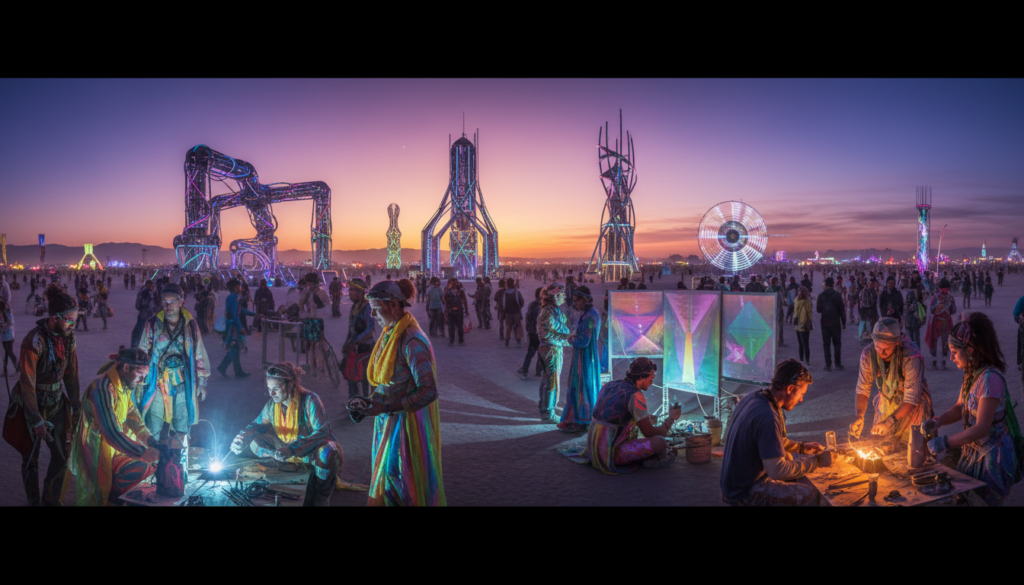
Upcoming schedule and the annual rhythm
Mark the dates: the next major gathering runs August 30–September 7, 2026. That timeline reminds participants to plan far ahead for camps, art builds, and travel.
The rhythm stays the same: build Black Rock City, operate it for a short window, then dismantle and restore the playa. That cycle repeats each year and shapes community planning.
Modern pressures and community debate
Recent years brought visible tensions: influencer attention, luxury camps, and lively debate about authenticity. These trends raise plain questions about access and equity.
Community choices now include policies and norms that try to keep participation central while managing new social forces.
Environmental risks and weather disruptions
Weather has reshaped operations. Heavy rain and flooding in 2023, plus dust and rain issues reported in 2025, show how climate events can limit movement and change schedules.
Organizers must plan contingencies for road closures, safety protocols, and cleanup when storms strike.
Financial sustainability and long-term data
Fundraising shortfalls and attendance challenges in 2024–2025 prompted clearer talks about fiscal resilience. Financial choices affect ticketing, grants, and support for art programs.
Bottom line: adapting budgets without losing core principles is a top concern.
“Protecting purpose while adapting to new limits will shape the years ahead.”
These tensions—logistics, culture, climate, and finance—set the stage for the conclusion, where the central question returns: why those founding ideals still matter as the event evolves.
Conclusion
For many, the clearest lesson comes from pitching in: the city works when you help it work. This event centers on community, large-scale art, shared rituals, and radical self-reliance.
How it happens: a set of principles, gifting, theme camps, hands-on projects, plus rituals like the Man burn and Temple build a living system that rewards contribution over spectatorship.
Use this guide as a planning tool. Learn the norms, bring supplies, and offer your skills. As burning man evolves, those core values remain a steady way to decide what to support, what to question, and how to join a meaningful place and experience.