

This guide helps you estimate a realistic daily target for safe, steady weight loss. The core idea is simple: energy in versus energy out, but real results vary by activity, metabolism, and how closely you follow a plan.
We focus on practical steps, not extreme cuts. You will learn how to estimate maintenance needs, pick a sensible deficit, track intake without obsession, and adjust as your body changes.
This article uses common U.S. activity ranges and safety guardrails. The best target depends on age, sex, current body mass, muscle, and daily activity. We give guidance for each factor and stress consistency, food quality, and habits you can keep week after week.
Key Takeaways
- Start by estimating maintenance calories, then choose a sustainable deficit.
- Adjust goals as your body and activity change.
- Focus on nutrition quality and consistent habits over quick fixes.
- Track intake, but avoid obsession; small steady steps win.
- The right target varies by individual—age, sex, muscle, and lifestyle matter.
Why calories matter for weight loss in 2026
Understanding energy balance is still the clearest starting point for steady progress in 2026. Evidence reviews show that an energy deficit remains the main driver of body change, but intake and expenditure shift as you change.

Calories in vs. calories out: the core model
Calories in vs. calories out means food energy eaten minus energy spent. If intake is lower than expenditure, most people lose fat over time.
Why results aren’t perfectly linear
Energy expenditure includes resting needs, movement, exercise, and digestion. All four parts change with body size and activity.
Progress may stall from fluid shifts, lapses in adherence, altered activity or metabolic adaptation. The body can lower energy use as mass drops, creating apparent plateaus.
| Component | Description | Why it matters |
|---|---|---|
| Resting metabolic rate | Energy used at rest | Largest single driver of daily needs |
| Physical activity | Daily movement and exercise | Most variable; rises with activity |
| Thermic effect of food | Digestion energy | Small but consistent; higher with protein |
Treat targets as estimates, not moral scores. Use trends and adjust plans for hybrid work and varied schedules in the next sections.
How many calories to lose weight based on your goal
Set realistic daily cuts and watch weekly trends, not single days. Small, steady deficits tend to protect energy, training, and mood while delivering reliable results.

What a 500-calorie deficit per day can do over a week
About 500 calories per day below maintenance stacks to roughly 3,500 calories in a week. That matches the common estimate for ~1 pound of body weight change, mostly from fat when done sensibly over time.
When a 1,000-calorie daily deficit may be too aggressive
Cutting ~1,000 calories per day can cause strong hunger, fatigue, and poor adherence. It raises the risk of muscle loss and harms training performance.
Why losing more than 2 pounds per week can backfire
Rapid drops often reflect water and glycogen shifts, not pure fat loss. Losing over ~2 lb per week raises the chance of metabolic slowdown and greater muscle loss, which slows future progress.
- Quick rule: start moderate, track 2–4 weeks, then adjust.
- Choose a goal that fits your starting body weight, activity, and how you feel.
Start with maintenance calories: BMR and total daily energy expenditure
Knowing your maintenance target is the practical first step for any plan that changes body composition. Maintenance is the daily amount that keeps your current weight steady. Find this number before choosing a deficit.

What BMR means and why it’s the foundation
BMR (basal metabolic rate) is the baseline burn your body needs to survive while fully at rest. It covers breathing, circulation, and cell repair.
How activity factors convert BMR to daily needs
Multiply BMR by an activity factor (roughly 1.2–1.95) to estimate TDEE, the total daily energy needs. This adds movement, exercise, and everyday tasks.
Common activity level ranges and what they include
- Sedentary: desk job, little planned exercise.
- Moderately active: daily walking plus 15–30 minutes of elevated-rate exercise.
- Very active: intense training 45–120 minutes or long physical jobs; very intense is 2+ hours.
Tip: Don’t confuse an occasional workout with all-day activity. Step count and job demands change your expenditure. Use these estimates as starting points and confirm maintenance by tracking trends over several weeks.
Choose a BMR formula: which calorie equation is most accurate?
Which BMR equation you choose affects your daily target and the path your progress takes.
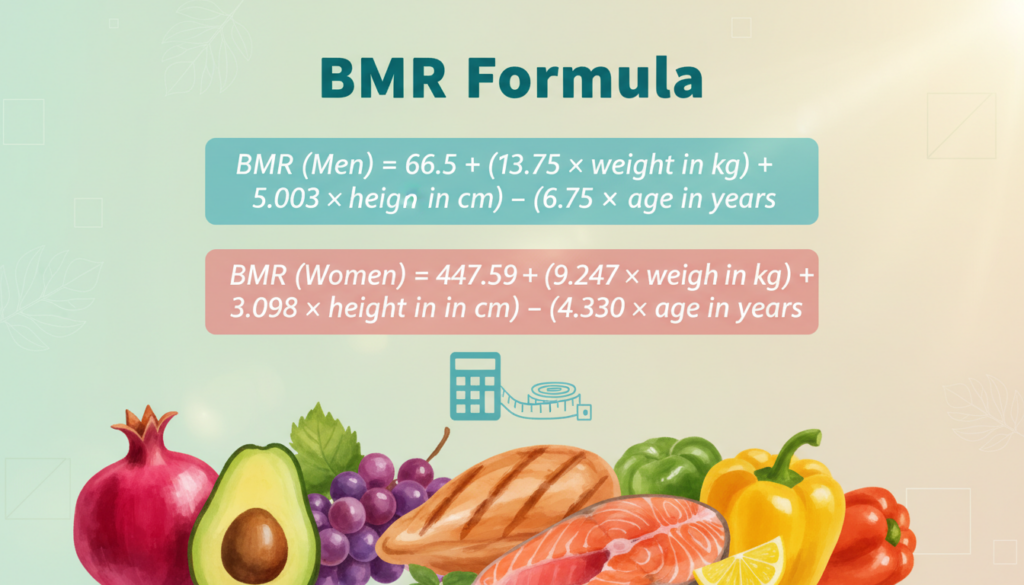
Why the formula matters: small differences in BMR change maintenance and your calorie goal. Pick a method that fits your data and goals, then track results for weeks.
Mifflin‑St Jeor (best general use)
When to use it: most people and modern calculators.
Men: BMR = 10W + 6.25H − 5A + 5
Women: BMR = 10W + 6.25H − 5A − 161
Revised Harris‑Benedict (legacy but valid)
Still useful for comparisons or if you’ve tracked with it before.
Men: BMR = 13.397W + 4.799H − 5.677A + 88.362
Women: BMR = 9.247W + 3.098H − 4.330A + 447.593
Katch‑McArdle (uses lean mass)
Best for people who know body fat percent and have high muscle mass.
BMR = 370 + 21.6 × (1 − F) × W (W in kg; F = body fat fraction)
| Formula | Best for | Key input |
|---|---|---|
| Mifflin‑St Jeor | General population | Weight, height, age, sex |
| Revised Harris‑Benedict | Legacy comparisons | Weight, height, age, sex |
| Katch‑McArdle | Lean or athletic bodies | Lean mass (needs body fat %) |
Don’t stress it: these are estimates. Use weekly trend data and adjust the plan if actual changes differ from predictions.
Key factors that change your daily calorie needs
Age, sex, size, muscle, and health all shape daily needs. These factors explain why two people eating the same may see different results.

Age and metabolism changes over time
Metabolism tends to slow with age. This reflects lower muscle mass and changes in hormones.
Recalculate targets after major life changes or long periods of progress. Small adjustments keep your plan realistic.
Sex differences: women vs. men and typical ranges
Men often have higher needs than women because they usually carry more muscle mass. This creates higher baseline energy use.
Typical ranges overlap widely; individual muscle and activity matter more than sex alone.
Height and body weight considerations
Taller and heavier bodies require more energy for daily function. Body weight is a primary driver of maintenance levels.
As mass falls, daily needs usually drop — so update targets after notable changes.
Muscle mass vs. fat mass
Muscle burns more energy at rest than fat. Preserving muscle during a deficit helps protect overall energy expenditure.
Strength training and adequate protein support muscle mass and steady progress.
Health conditions and medications
Certain conditions and drugs shift metabolism and appetite. Thyroid disorders, diabetes medications, antidepressants, and steroids can alter needs.
If health issues apply, consult a clinician. Personalized guidance prevents surprises and keeps intake appropriate.
| Factor | Typical effect | Practical note |
|---|---|---|
| Age | Decreases baseline energy | Recalculate periodically as muscle and activity change |
| Sex | Men often higher due to more muscle | Use individual measures rather than assumptions |
| Body size | Larger bodies use more energy | Height and current weight both matter for maintenance |
| Muscle vs. fat | More muscle = higher resting burn | Prioritize resistance training and protein |
| Health/meds | Can raise or lower needs | Talk with a doctor when changes occur |
General US calorie guidelines by activity level
Everyday activity shapes a wide band of reasonable daily intake for adults in the United States.
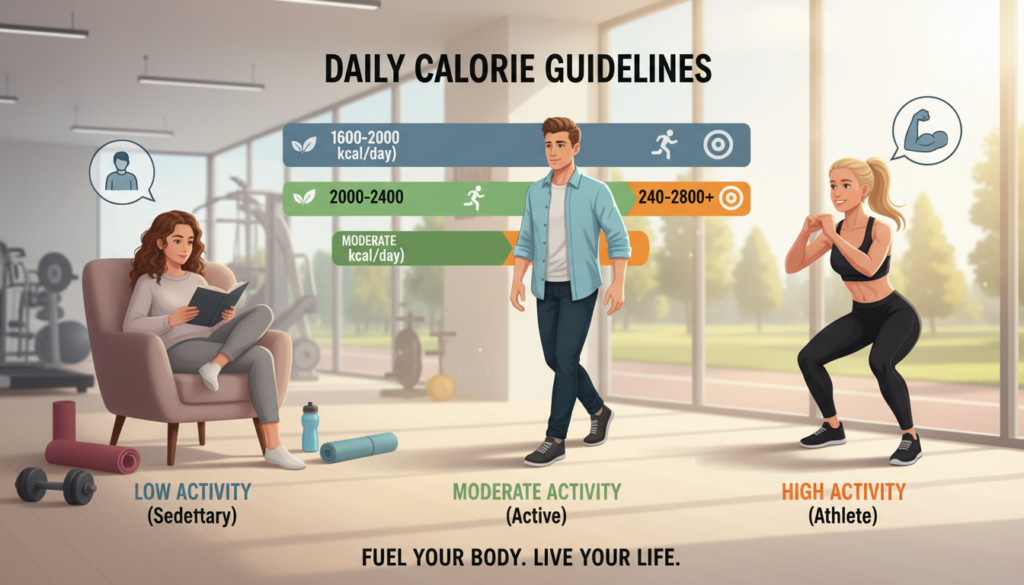
Use these ranges as a starting estimate. Compare them with your calculator results and real-world tracking. Then pick a point within the band that fits your size and daily movement.
Sedentary estimates
Women: 1,800–2,400 calories per day.
Men: 2,200–3,000 calories per day.
Moderately active estimates
Women: 2,000–2,600 calories per day.
Men: 2,400–2,800 calories per day.
Very active estimates
Women: 2,200–2,800 calories per day.
Men: 2,800–3,200 calories per day.
Why ranges are broad: “moderately active” can mean a desk job plus daily walks, or a job with long hours on foot and planned training. Choose the lower end if your day is mostly sitting. Choose the higher end if you’re tall, heavier, or spend many hours moving.
Practical steps: Treat these as guidelines, not orders. For a quick check, track consistent intake and weekly averages for two weeks. If numbers diverge from your calculator, adjust the range and retest.
For a simple habit nudge, pair better food choices with steady activity. If you want a quick reference for a snack that fits balanced plans, consider the comfort snack.
Set a realistic calorie deficit you can maintain
A sustainable calorie cut blends with your daily routine and supports steady progress. Pick a target that protects mood, training, and long-term habits rather than chasing fast results.

How to pick a target: mild, moderate, or faster loss
Mild: a small daily shortfall that eases adherence. Good for busy schedules or low activity levels.
Moderate: common guidance suggests a 500–750 reduction per day. This balances steady loss with preserved energy for exercise.
Faster: only for short periods and under good planning. Aggressive cuts raise hunger, harm performance, and increase rebound risk.
How to adjust if you’re highly active
If you train hard, keep the deficit smaller and prioritize fuel around workouts. Avoid deep cuts on training days.
- Swap snack choices or trim portions for a 500–750 daily change.
- Replace sugary drinks with water and add protein at meals.
- Judge progress by weekly averages, not single days, and adjust after consistent tracking.
Practical note: the best plan fits your schedule and diet style. Small, steady steps usually win. For unrelated budgeting tips that pair with lifestyle planning, consider smart budgeting.
Minimum calorie intake and safety guardrails
Safe minimum intake limits exist so you can protect health while pursuing an energy deficit. These baselines help preserve daily function, nutrition, and exercise performance as you adjust eating and activity.

Common minimums
Most guidance sets simple floor values: about 1,200 calories per day for women and roughly 1,500 calories per day for men unless a clinician advises otherwise.
Why large cuts are discouraged
Dropping more than a 1,000-calorie daily gap raises the chance of fatigue, poor adherence, and nutrient shortfalls. It also increases risk of muscle loss and adverse metabolic responses.
Very‑low‑calorie diets and medical supervision
Very-low-calorie diets (typically under 800 calorie per day) are clinical tools. They require monitoring and are not DIY plans.
- Extra caution if you have heart rhythm issues, kidney disease, pregnancy, type 1 diabetes, or frailty in older adults.
- If health conditions apply, consult a clinician before changing intake.
Practical tip: If your target falls below recommended minimums, raise intake or scale back activity rather than pushing a deeper cut. Safety includes functioning well and meeting nutrition needs, not just seeing the scale move.
What happens when your calorie intake is too low
When daily energy is chronically low, the body shifts gears to conserve fuel and protect vital systems.

Metabolic slowdown and plateaus
Metabolic adaptation means the body lowers daily burn when intake stays too small. This change makes progress stall despite strict tracking.
In plain terms: your body becomes more efficient and needs fewer calories for the same tasks.
Muscle loss and long-term BMR changes
Steep deficits—especially with low protein and no resistance work—raise the chance of losing muscle mass.
Less muscle lowers resting energy use. Over months, that drop can slow future progress and make gains harder to sustain.
Nutrient shortfalls, fatigue, and mood shifts
Eating too little often brings nutrient gaps that affect hair, skin, immunity, and sleep.
Common signs of under-eating include persistent tiredness, irritability, feeling cold, and low motivation for movement.
Heart, hormonal, and digestive effects to watch
Serious effects can include lightheadedness, irregular heartbeat, missed menstrual cycles, and constipation.
Rapid or extreme restriction may also increase gallstone risk and worsen existing conditions.
“Listen to persistent signals from your body—stalled progress plus ongoing fatigue usually means you need a safer plan.”
| Problem | Common signs | Practical fix |
|---|---|---|
| Metabolic slowdown | Plateau, low energy | Raise intake slightly, track weekly averages |
| Muscle loss | Weaker lifts, less tone | Prioritize protein, add strength training |
| Nutrient gaps | Hair loss, poor immunity | Choose nutrient-dense meals, consider a check-up |
| Cardio & hormonal risks | Low BP, irregular cycles | See a clinician if symptoms appear |
Gentle correction path: raise daily intake a bit, focus on protein and fiber, keep strength sessions, and choose a steady plan you can sustain. Small changes often restore energy and restart progress without added risk.
Calories per pound: how the 3,500‑calorie rule fits (and where it doesn’t)
Treat 3,500 as a planning shortcut, not a promise. One pound roughly equals 3,500 calorie deficit, so a 500 daily shortfall stacks to about 3,500 in seven days and suggests ~1 lb of fat change that week.
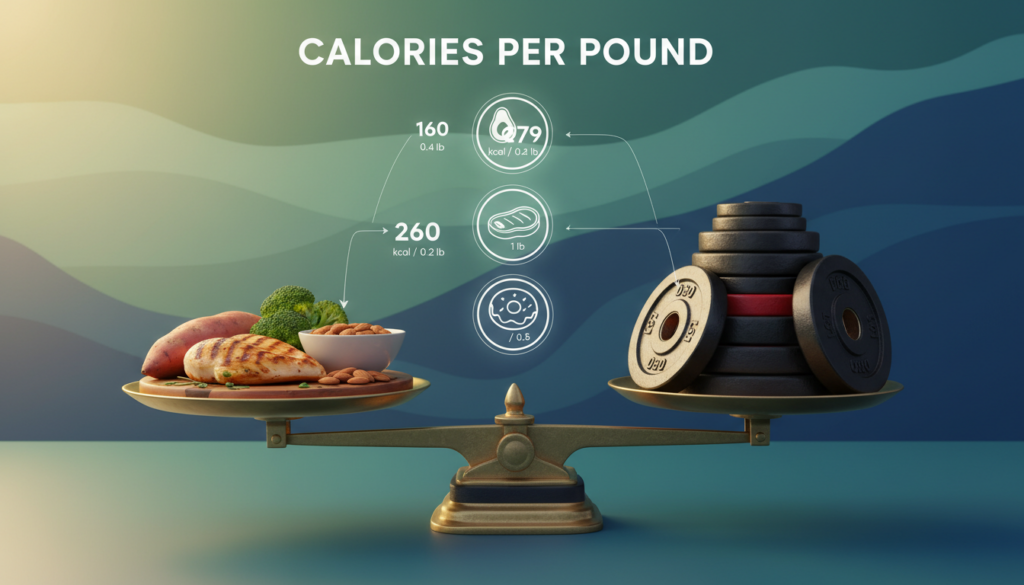
Using the 3,500 estimate for weekly planning
Use it to set expectations and pick a steady daily target. Small, consistent gaps are easier to maintain and protect energy and muscle.
Why day‑to‑day scale swings can mislead
Water, glycogen, and meal timing can shift readings by several pounds across days. Metabolic adaptation and changes in movement also alter real outcomes, so the math will not always match the scale.
- Weigh under the same conditions: morning, after bathroom, before food.
- Focus on week‑by‑week averages rather than single readings.
- Pair scale trends with measurements, photos, and how clothes fit for a fuller picture.
“Weekly trends beat daily drama—use multiple signals for a clearer read on fat change.”
Step-by-step: calculate your daily calorie target for fat loss
Use a simple calculation sequence that turns personal stats into a workable daily intake. Below are five clear steps you can finish in one sitting.

-
Estimate BMR with a chosen equation
Pick Mifflin‑St Jeor for most people. Choose Katch‑McArdle if you know body fat percentage.
-
Multiply by an activity factor
Apply a realistic factor (about 1.2–1.95) to convert BMR into maintenance calories. Be honest about daily movement when selecting the level.
-
Subtract a sustainable deficit
Trim roughly 500–750 per day from maintenance for steady loss, while staying above common minimum intake guardrails.
-
Track progress for 2–4 weeks
Judge by weekly averages, not single-day swings. Adjust intake if the trend is faster or slower than expected.
-
Recalculate after meaningful changes
Update targets when body weight or activity patterns shift. Regular recalculation keeps goals accurate as energy expenditure changes.
Remember: the aim is consistent loss with good energy and preserved performance, not the smallest possible number. For lifestyle pairings and budgeting tips that fit steady plans, see smart utility savings.
Track calorie intake without obsessing
A few weeks of focused tracking teaches portion sizes so you can relax later.

Apps, labels, and restaurant estimates
Use a simple app to log meals and learn patterns. Scan barcodes, check nutrition labels, and pick the closest restaurant match when dining out.
Tip: log an estimate and move on—perfect precision isn’t required for steady progress.
Portion control strategies that reduce daily intake naturally
- Measure and log your most common meal for two weeks, then eyeball similar portions later.
- Use smaller plates, pre-portion snacks, and fill half the plate with produce first.
- Prioritize protein at each meal to stay full longer.
Why weekly averages beat daily weigh-ins
Daily swings are normal. Track intake and scale readings by week and focus on trends.
“Use tracking as feedback, not punishment.”
| Tool | When to use | Practical tip |
|---|---|---|
| Food tracking app | Daily logging phase | Scan labels and save favorite meals |
| Nutrition labels | Packaged foods | Check serving size, then measure |
| Restaurant estimates | Eating out | Pick a similar menu item and log it |
Food quality and macros that support weight loss
What you eat matters beyond the numbers: food choices shape hunger, performance, and long-term results. Good nutrition makes a deficit easier to sustain and protects health markers like blood lipids and energy.

Protein: satiety and preserving lean muscle
Adequate protein preserves muscle during a deficit and increases fullness between meals. Simple options include Greek yogurt, chicken, tofu, beans, and eggs.
Carbohydrates, sugar, and fiber
Prioritize high-fiber carbohydrates such as oats, beans, whole grains, potatoes, and fruit. These choices slow digestion and reduce hunger.
Cut back on added sugar when it crowds out more nutritious food. Replace sugary snacks with fruit or plain popcorn for volume without excess energy.
Energy-dense foods versus low-calorie volume
Some foods pack many calories in small portions—nuts, oils, and ice cream—while others offer bulk for fewer calories, like vegetables, berries, and air-popped popcorn.
Alcohol and budgeted intake
Alcohol gives mainly empty calories and can lower inhibition, raising overall intake. If you drink, plan those servings in your diet pattern and favor lower-proof options.
- Pattern-based advice: lean Mediterranean-style choices and minimally processed foods support long-term loss and cardiometabolic health.
- For comfort-food swaps that keep flavor and nutrition, see comfort food that is healthy.
“Food quality changes hunger, mood, and health even when intake targets remain the same.”
Increase energy expenditure with physical activity
Small boosts in activity raise daily energy use and let you aim for a gentler intake plan while keeping progress steady.

Exercise time and intensity: real examples
Short, brisk sessions of 15–30 minutes raise heart rate and give a modest calorie return. Intervals produce higher burn per minute while also improving fitness.
Longer efforts of 45–120 minutes create bigger energy gaps for endurance training or extended walks. Very long days (2+ hours) markedly increase total expenditure but need planned recovery.
Strength training to protect muscle mass
Preserving muscle matters. More muscle helps keep resting energy higher and improves body composition during a deficit.
Start with 2–3 full‑body sessions per week. Focus on progressive overload: small reps increases, slightly heavier sets, or more volume over weeks. Prioritize form over load.
| Activity | Typical time | Approximate calories/hour | When it fits |
|---|---|---|---|
| Brisk walking | 15–60 min | 200–350 | Daily warm-up or lunch break |
| High‑intensity intervals | 15–30 min | 400–600 | Short efficient workouts |
| Endurance session | 45–120 min | 300–700 | Weekend training or long active days |
More isn’t always better: excess intensity raises stress, hunger, and injury risk. Balance training with recovery, sleep, and a sensible plan for long-term loss and health.
Practical note: pair active days with higher fuel for performance, and use light movement on rest days. For broader lifestyle tips that support sustainable habit shifts, see simple money habits.
Break through plateaus with zigzag calorie cycling
Sometimes progress stalls even when eating and training stay consistent—biology and tracking quirks often explain why.
What a plateau is: your body adapts, your mass falls, and small tracking drift adds up. That trio can pause visible change even with steady effort.
Zigzag calorie cycling keeps the same weekly total while varying daily intake. This gives flexibility and can blunt adaptation by sending slightly different signals across the week.
How weekly totals stay the same while daily numbers vary
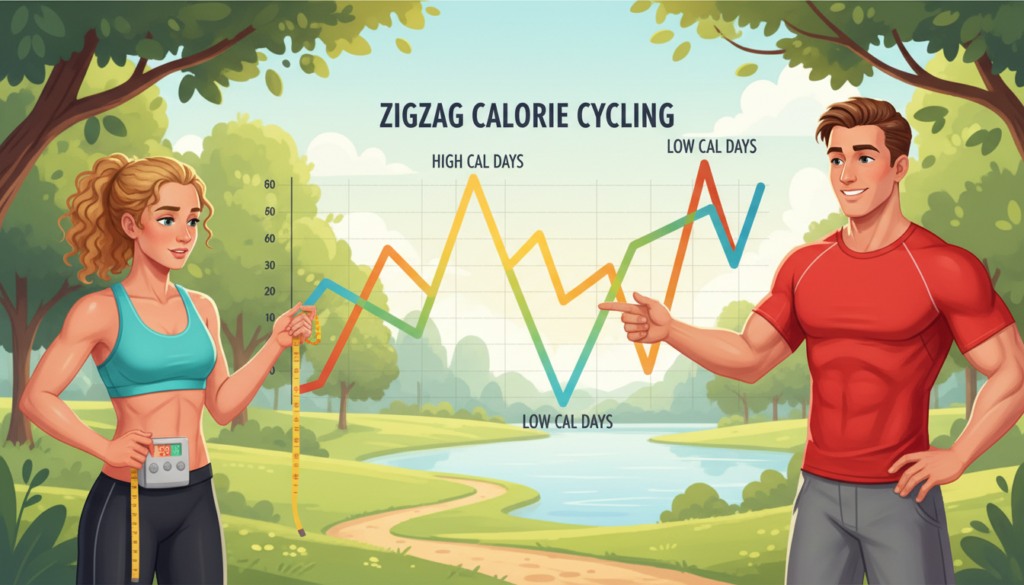
Example: a 14,000 weekly target can be 2,000 each day or split as 2,300 for three days and 1,775 for four days. Both hit the same week total but feel easier for people with active and rest days.
Plan higher days around workouts and social meals
Schedule bigger meals on training days, travel days, or events. This preserves performance and lets you enjoy social time without abandoning your diet.
Typical swings and guardrails
Most people use 200–300 swings per day. Use larger shifts only if activity level is very high. Cycling is structure, not permission for binges—keep protein, portions, and weekly totals in check.
Conclusion
Make a short, measurable plan this week and treat the next two weeks as data collection.
Start by estimating maintenance, pick a sustainable deficit you can follow, and track weekly intake and trends. Adjust targets as your body and activity change over time.
Keep safety first: avoid extreme cuts and respect common minimums (about 1,200 for women and 1,500 for men). Seek medical advice if a health condition affects your plan.
Favor foods that help you feel full and energised: protein, fiber-rich produce, and minimally processed meals. Plateaus are normal—recalculate, tweak activity, or use zigzag cycling to move forward.
Next step: pick a calculator method, set a starting target for the week, and commit to two weeks of tracking before large changes.